

In many jurisdictions, a routine encounter with the police (for example, a traffic stop, or a peaceful protest) may lead to an officer posing some variant of the question: ‘For my safety, are you carrying a weapon?’ The idea is that if you are, the officer would relieve you of the weapon for the duration of the encounter. For his safety.
Of course, even if you are carrying a weapon, the right answer to the question is no. You’re carrying it for your safety, not the officer’s.
Which brings up an important and often overlooked point. If a police officer can insist that you be disarmed because it makes him feel safer, then you — as his employer — can insist on exactly the same thing, for exactly the same reason.
When thinking about the police, it’s always good to remember what Sir Robert Peel, the inventor of the professional police force, had to say:
The police are the public and the public are the police; the police being only members of the public who are paid to give full-time attention to duties which are incumbent on every citizen.
That is, the police don’t have extra rights, or extra powers. They just have extra training, and collect a paycheck (which comes out of your pocket) for what the rest of us are supposed to do for free.
So if I’m supposed to disarm myself to make an officer feel safer, why shouldn’t he have to do the same thing to make me feel safer? To put that another way, if he needs his gun to protect himself from you, then don’t you need yours to protect yourself from him?
There are about 700 thousand police officers in the US, who shoot about 1,000 people a year. So about 1 in 700 police officers are going to shoot someone in any given year.
There are about 250 million adults in the US, who shoot about 15,000 other people a year. So about 1 in 17,000 adults are going to shoot someone in a given year.
Obviously there are statistical subtleties that I’m ignoring, but a quick order-of-magnitude calculation suggests that a police officer is more than twenty times as likely to shoot you as you are to shoot him¹.
So if anyone is going to be disarmed during an encounter with the police, it should be the officer, and not you. For your safety.
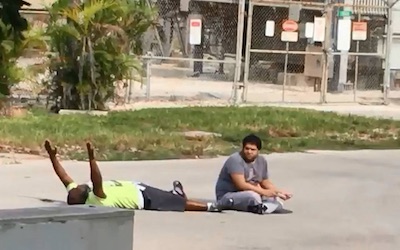
¹ Now you might be thinking: The police are highly trained, and rigorously selected, and can be trusted not to shoot you unless you have it coming. If you are thinking that, I invite you to do a little reading about what happened to Charles Kinsey, the man in the featured image who is lying on the ground with his hands clearly visible in the air.
Spoiler alert: A SWAT officer — the best of the best, right? — who had been informed that Kinsey’s autistic patient was holding a toy truck decided that it was a gun, and tried to shoot the patient — from the SWAT equivalent of point-blank range — but missed, hitting Kinsey instead.
Now you might be thinking: That’s just a rare, isolated incident. If you are thinking that, I invite you to head over to the Marshall Project web site, where you can read about as many other similar cases as you have the time (and the stomach) for.
