

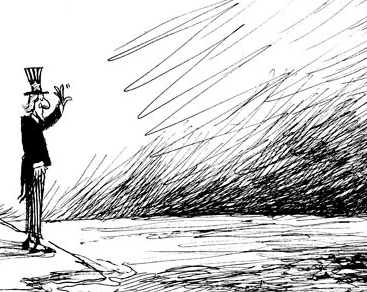
As I’ve said before, the Supreme Court’s primary job is to preserve the illusion that it can do whatever it wants. Recently, it decided that the best way to do this would be to declare that the participants in an election — 19 out of 50 states — didn’t have standing to challenge irregularities in the process by which the election was conducted.
My prediction at the time was that, regardless of the merits of any cases submitted to it, the court would find a way to let the left prevail — whether by hearing cases that would force it to issue tortuous rulings, or by refusing to hear any cases at all (which is what happened).
But why would it do that?
In a nutshell, because the left had already spent months demonstrating that if it didn’t prevail, it would burn the country down, city by city. And the right, being composed largely of people who own businesses and homes and other property, could be expected to be reluctant to destroy other people’s property.
Which is exactly what we saw confirmed yesterday. A huge number of protesters from the right showed up to protest in Washington, DC, and the city is still standing. If that protest had been staged by the left — for example, in response to a ruling from the court requiring states to follow their own constitutions — the Capitol, and much of the city itself, would be a smoking pile of ruins today.
Which is to say, the court submitted to blackmail.
So what’s next?
Well, somewhere between secession and submission lies what progressives like to call ‘a middle way’. The 19 states who were told by the federal government that they didn’t have standing should return the favor, and stop recognizing the government chartered by the Constitution as having standing to interfere in their affairs — by recognizing instead the government chartered by the Articles of Confederation, a union which was declared perpetual and never formally dissolved.
That is, the states were sovereign entities before they ratified the Constitution. They never surrendered that sovereignty. And the constitutional experiment has shown decisively that whatever benefits there might be in a ‘strong central government’, they are outweighed many times over by the costs.
The Articles were designed for the purpose of mutual protection, whereas the Constitution has morphed into a tool for mutual exploitation. And the Articles don’t require maintaining the pretense that officials whose goals are very different from your own can ‘represent’ you in any meaningful way when it comes to making policy.
As Carla Gericke likes to say, it’s time to Make America States Again.
Will this happen? Probably not. As our own Declaration of Independence notes, ‘all experience hath shewn, that mankind are more disposed to suffer, while evils are sufferable, than to right themselves by abolishing the forms to which they are accustomed’.
But it’s by far the best way out of the mess we find ourselves in now.
