

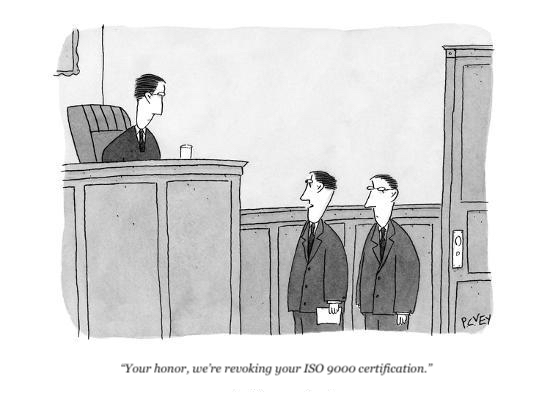
Recently, I was talking with a friend who used to work at a company that obtained ISO 9000 certification. Before certification, knowledge would be passed on informally, from old employees to new ones. For example, if you knew how to run a machine, or implement a process, you would teach what you knew to your replacement. But ISO 9000 certification changed that.
The way he explained it, if you’re ISO 9000 certified, then ‘you write down what you do, and you do what you write down’. Which made me think of what I have often said is the heart of the rule of law, and the core of my political philosophy:
We should write down what we’re going to do, and then do that. If we decide that we should be doing something else, we should write that down instead, and do it. But what we should never do is write down that we’re going to do one thing, then do something else, and pretend that they are the same.
Of course, writing down that we’re going to do one thing (like leave the right to keep and bear arms uninfringed, or require warrants before conducting searches) but doing something else (like passing laws that infringe the right to keep and bear arms, or inventing lists of exceptions to allow warrantless searches) is pretty much standard procedure in American government.
One of the keys to making ISO 9000 certification work is that there is an audit process: An auditor looks at the written description of a task, watches the task being performed, and verifies that the actions match the description. If they don’t match, the company either has to change what it’s doing to match the description, or change the description to match what it’s doing.
That seems simple enough, right? But here’s the crucial part: The auditor is from outside the company. That’s what makes it all work.
Consider what happens when our government decides that it wants to ignore a limitation placed on it by the constitution that created it. One part of the government passes a law or issues a regulation, and then if there’s a challenge, another part of the same government issues a decision on whether the government is overstepping its authority. Which is crazy.
(Or consider what happens when a law enforcement officer — who is part of the government — is accused of misconduct. In that case, the same part of the same government issues a decision on whether the government’s conduct was justified. Which is beyond crazy.)
Suppose that independent ISO 9000 auditors were authorized to review the decisions of federal and state appeals courts, to see how well each decision matches up with the written description that the decision is supposed to implement — in this case, the relevant constitutions.
It would change everything. Gun control laws? Gone. Laws abridging freedom of speech? Gone. Exceptions to warrantless searches? Gone. Virtually every law that relies on the interstate commerce clause to rationalize regulations on businesses? Gone. Wealth redistribution programs? Gone. And so on.
We would be required, if we wanted to do any of those things, to write down that we’re going to do them, by amending the relevant constitutions.
One of the great things about ‘writing down what you do, and doing what you write down’ is that if your processes are certified, it doesn’t matter all that much who is carrying them out. Anyone following the directions will produce the same results.
Contrast that with how the US Supreme Court operates. It’s practically the opposite. Almost everything depends on who is sitting in those seats, and the written description (i.e., the written Constitution) matters almost not at all.
Which is to say, if we applied the ISO 9000 methodology to our government, we would have the rule of law. Without it, we have the rule of men.
We have come to expect this level of accountability from the companies that produce our cars, our computers and electronic devices, even our clothing. What possible reason could we have for not demanding it from our government?
