


When you talk to people about educating their children outside of traditional schools, one of the things you’re likely to hear is some variation of ‘But I can’t teach my children’ math, or chemistry, or music, or some other subjects that they aren’t familiar with. And while they may be right, they’re also wrong.
How do you make a plant grow? You don’t. You prepare the conditions, and maybe add some water and fertilizer, and the plant does all the work.
How do you teach a kid chemistry? You don’t. You prepare the conditions, and provide access to some resources, and the kid does all the work.
But wait — what does that mean, prepare the conditions? For the most part, it means teaching the kid to read and write well enough to be able to continue teaching himself to get better at those things. Once he can read and write at a 6th grade level, the only thing standing between him and being able to read and write at college level is more practice.
And once he can read and write at college level, the only thing standing between him and anything he wants to learn, is… well, there isn’t anything. Even if an Ivy League degree is financially out of reach, an Ivy League education is now free.
It can’t be that simple, can it?
At one time, it wasn’t. Abe Lincoln had to walk miles to borrow a few books from his neighbors. People my age could walk to local libraries instead.
But today, if you can have a coherent conversation in writing, there is nothing that you can’t learn, because there are a lot of people who would love nothing more than to help you learn whatever you want, often for free. And they are available 24 hours a day, 7 days a week, 365 days a year.
(For nearly 20 years, I managed a free site called Ask Dr. Math, where volunteers would come home from their day jobs to help people learn math by exchanging email messages… for no reward other than the love of doing it.)
And one of the things that some of those people want to help you with is learning to read more fluently and with better comprehension, and how to write more effectively.
So, how do you teach a kid chemistry, even if you don’t know the first thing about it? You make sure that the kid can read well enough to work through a chemistry text, and write well enough to be able to pose questions on forums where he can get more competent help than he’s likely to get at your local school. And you help him understand his motivation for wanting to learn it, so he’ll be able to push through rough patches.
Okay, but can you teach your child to read? If you know how to read, and he’s a normal child, then yes, there’s absolutely no question that you can. If you think there’s some technical knowledge that you lack, there are roughly a zillion apps and other resources that you can turn to for help. If you lack confidence, look at some of John Holt’s books for inspiration.
Of course, you could rely on your local schools to teach him to read. But then you only have about a 40% chance of success. You’re basically flipping a coin, except it’s weighted slightly against you.
Which puts the issue in a somewhat different light. Then the question becomes, not ‘Can I teach my child to read?’, but ‘Can I afford not to teach my child to read?’
And that raises another question. Can all of us, as taxpayers, afford to continue letting kids avoid learning to read? A couple of simple graphs should illustrate why we can’t.
The first graph shows per-student spending in our current paradigm, where we accept that most kids just aren’t going to be able to read well enough to work through a textbook, so we have to pay people (teachers) to read the books to them. The more specialized the book, the more we have to pay someone to do the reading. So that ends up looking like this:
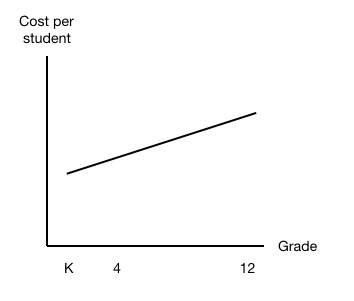
In a different paradigm, we would be focusing on helping every educable student learn to read and write well enough to continue his own education, at which point teachers are mainly coaches — helping students identify which materials might work best for them, assisting with motivation, and so on. That would look more like this:
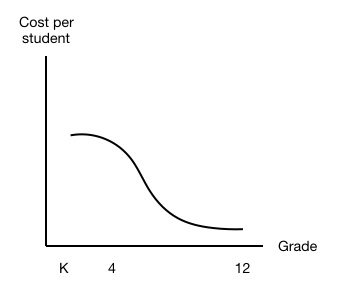
That is, as kids become more capable of doing the work of learning, instead of sitting around waiting for their teachers to do it for them, the cost of educating them rapidly approaches zero dollars per student.
Want to slash your school taxes? This is how.
