

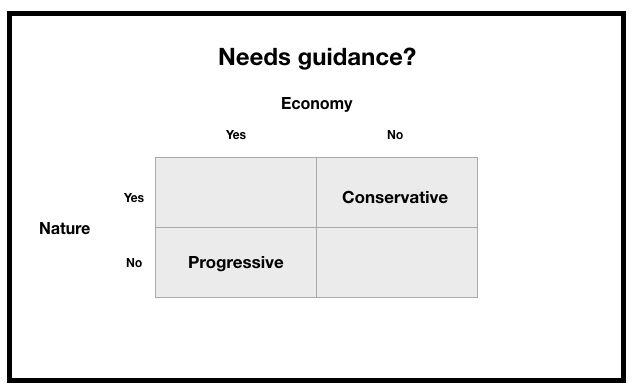
Conservatives often refuse to believe in evolution, because they don’t see how something as complex as nature could operate without someone in charge of it. At the same time, they are comfortable with the idea that something as complex as an economy could operate without guidance.
Progressives often take the opposite positions: that something as complex as an economy requires someone to be in charge, while nature can operate without guidance.
Why is that? I used to think it was just failure of imagination. That is, if you look at something as complicated as an eye, it’s easy to think that someone had to design it. It takes a certain quantity and quality of imagination to see that it could develop gradually over time through a combination of mutation and selection pressure.
Or, if you look at something as complicated as how food gets produced and delivered to people who want it, it’s easy to think that without someone to manage the process, some places would necessarily end up with no food, and other places with too much. It takes a certain quantity and quality of imagination to see that it can happen through a combination of motivation and prices.
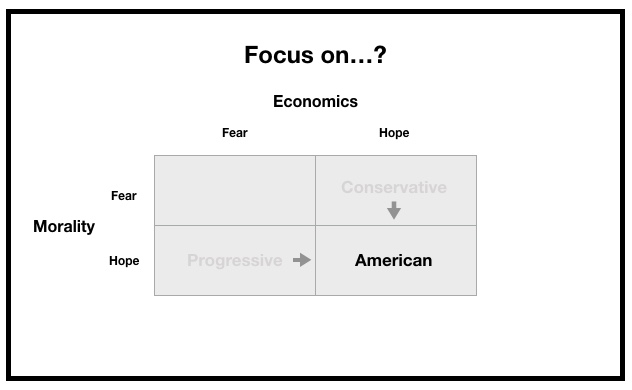
But now I think that there is a different explanation. As the table above shows, each group demonstrates the capacity to understand that complex systems can operate on their own, without anyone in charge; but each group embraces that idea only in some contexts, while running away from it in others.
So I think it’s not a lack of imagination that prevents conservatives or progressives from being able to resist interfering in situations that would be better off without their ‘help’.
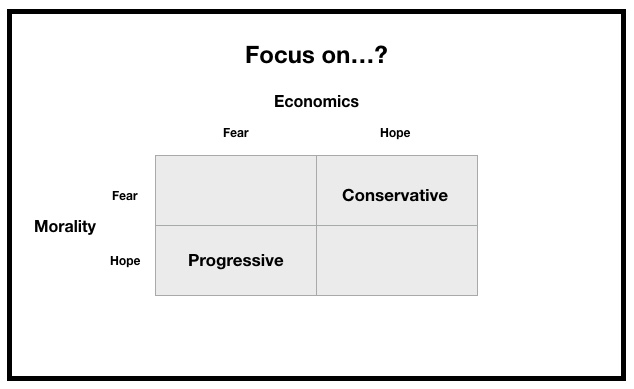
Rather, it’s that in some contexts, each group focuses on what might go right, while in other contexts, the same group focuses on what might go wrong.
In the context of economics, conservatives tend to look at the potential upsides of removing artificial constraints from voluntary agreements. Think of the new technologies that will be developed in response to consumer demand! Think of how hunger will be decreased with innovations in the production, distribution, and design of food products! Think of the medical problems that will be mitigated, or eliminated, if we can just get government out of the way!
But in the context of what we might call ‘morality’ (by which I mean sins and vices, as opposed to actual crimes), those same conservatives tend to look at the potential downsides of removing artificial constraints from voluntary agreements. Think of how civilization will collapse if we let gays marry, or raise children! Think of how society will devolve if we allow people to make their own decisions about what kinds of substances they can ingest! Think of how the minds of children will be ruined if we let the wrong people march in parades!
On the other hand, progressives tend to look at the potential upsides where morality is concerned, and the potential downsides where economics is concerned.
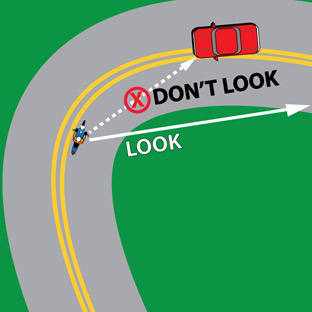
Years ago, I took a course on riding a motorcycle. The thing I remember most vividly from that course was the advice to look, not at what you want to avoid, but at where you want to go — because where you look is where you’ll end up.
I think the same thing applies to politics — the more we focus on what we don’t want (drug use, poverty), the more of that we end up getting. Where we look is where we end up.
There is a meme going around, which is a twist on the advice that you should try to be the person your dog thinks you are:
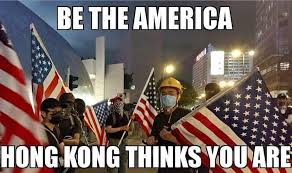
It’s great advice. But how do we do that? By changing what we focus on:
It’s that simple… and that difficult.
