

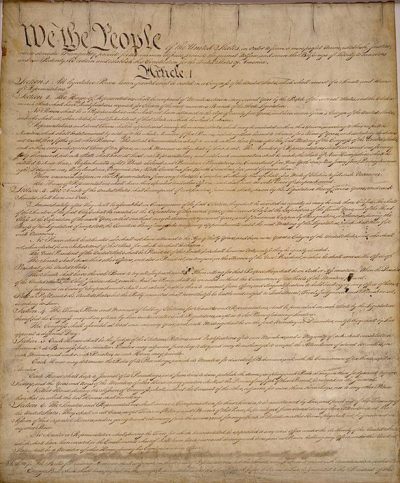
How it was written?
When Jay, Madison, and Hamilton wrote the Federalist Papers they were fresh from writing the US Constitution. Madison and Hamilton are credited with writing more of it than any other two participants in the process. Certainly several dozen people participated in the argumentation, composition and passage of the document. The writers came together to produce the constitution. They spent the months from May through September in a closed room in Philadelphia. They worked with the delegates from the states in composing the constitution.
Did the framers like it, or was the constitution political sausage?
The writers studied hard before they undertook the task of writing the constitution. The finished product was not exactly what they wanted it when the process started. But The Federalist Papers are testimony to how much they liked it by the time the process was complete. So, just having written the document, having debated every point in it, with a lot of very impressive people in the room, Jay, Hamilton, and Madison wrote out why it was so. That too makes these essays authoritative because it isn’t just letters by random supporters after the fact. They are the thoughts and reasoning of the people who actually wrote the constitution; people of very high quality with personal involvement.
Who read them and why?
The Federalist papers are also important because of who read them. That touches on something fundamental to the constitution, something mentioned often in the Federalist. They were read by people who were deciding on their selections for delegates to state ratifying conventions. Those delegates would vote for or against the constitution as proposed.
It was an exciting and intense time in America. The essays were published in New York with the ratification debate in progress. As you might imagine they had their main political effect in New York. They were circulated. But, they did not make it everywhere. The timeline of how they unfolded is instructive. The constitution of the U.S. was the subject of a grand national debate.
Why not just modify the Articles of Confederation?
One of the defects of the Articles of Confederation that the Federalist Papers talked about quite a bit was that the Articles of Confederation were passed by the Continental Congress as an ordinary law. And then the Continental Congress acted under that law. That meant that they weren’t anything above an ordinary law. If Congress wanted to change the law they could, quite easily.
The Constitution, on the other hand, was passed by delegates to the ratifying convention in the states, elected by the people of each state for that one special and specific purpose. The states each had to hold a ratifying convention. Some states chose to hold more than one; ostensibly they did not get the answer they liked the first time. So they came back and got a different answer. Or perhaps they did not reach a conclusion the first time, so they came back to a second convention in order to reach said conclusion.
Decision time
The people in the county were reading the proposed constitution. They had, under the principles of the Federalist Papers and of the American Founding, a right to choose their form of government. The consent of the governed is a fundamental principle of America. This was decision time.
The people were about to give or withhold their consent. The Federalist Papers essays were written by the people who wrote the constitution for them and are offering it to read, understand and vote on. They were written to help the voters make up their minds. They offered the considerations and justification considered by those who made the document. Reading them is to gain historical insight.