

FOR IMMEDIATE RELEASE October 30, 2026
Contact: Thomas J. Murray Jr. · 781-389-6107 · Tom@GIPAmerica.org
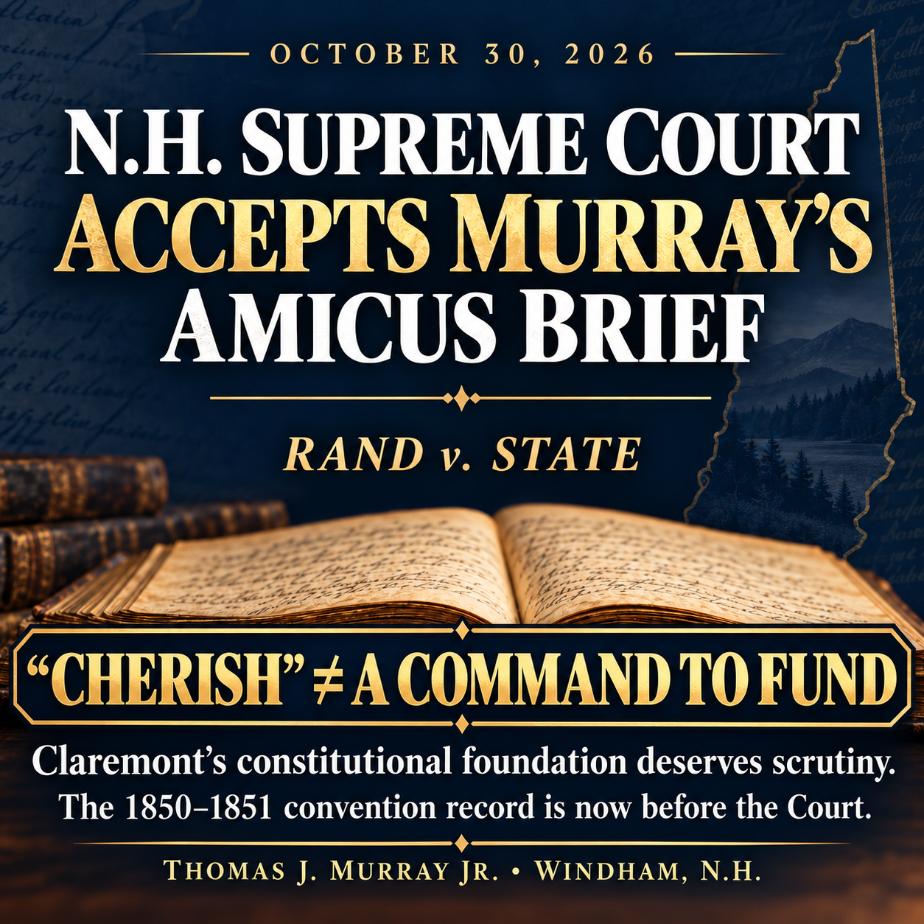
N.H. Supreme Court Accepts Windham Resident’s Amicus Brief Placing 1850 Constitutional Convention Record Before the Court in Rand v. State
Brief, filed in support of neither party, documents how the 1850 Convention drafted an express school-funding mandate for Part II, Article 83 — and how voters rejected it
WINDHAM, N.H. — The New Hampshire Supreme Court on Friday granted Windham resident Thomas J. Murray Jr. leave to file an amicus curiae brief in Steven Rand & a. v. State of New Hampshire, No. 2026-0150, the pending appeal in which the State has asked the Court to reconsider the historical foundation of the Claremont school-funding decisions. The order, entered by Justice Countway, accepts the brief as filed on September 10, 2026.
Murray, who is self-represented, filed in support of neither party. The brief does not urge affirmance or reversal and does not ask the Court to decide the adequacy, tax-rate, or remedy questions on appeal. It asks one thing: that if the Court reaches the historical premise of Claremont, it consider the official Journal of New Hampshire’s 1850–1851 Fifth Constitutional Convention in its actual documentary sequence.
A record the Claremont courts never had
The Convention’s manuscript Journal was never printed in its own time. According to William Garner, the Secretary of State’s 2005 introduction, it was relocated to the State Archives in 1980, when its existence was “unknown to living researchers”, and it was first published by the Department of State in 2005 — twelve years after Claremont I (1993) and eight years after Claremont II (1997).
What the Journal shows
The brief traces the Convention’s handling of school funding step by step:
- November 16, 1850 — Delegate J. H. Steele of Peterborough moved that the Committee on Education frame an article to be inserted in the Constitution “making it imperative on the legislature” to provide for a school assessment on the State inventory. The Convention adopted the resolution on November 19.
- November 21, 1850 — Reporting for the Education Committee, Levi W. Leonard wrote that if more pecuniary means were needed, “there should be a provision in the constitution authorizing and requiring the legislature to grant them.”
- November 21, 1850 — The same day, the Bill of Rights committee reported striking from Part I, Article 6 the words “the legislature to authorize from time to time” and “towns, parishes, bodies corporate or.”
- December 26, 1850 — The Convention proposed replacing Article 83’s “cherish” language with an express command: “The Legislature shall make provision for the establishment and maintenance of free common schools at the public expense,” with annual assessment and collection of not less than $125 for every dollar of State taxes, “to be applied exclusively to the support of such schools.”
- March 1851 — Voters rejected the proposals at town meeting. The Bill of Rights package failed 14,456 to 24,342; the “other alterations and amendments,” which included the funding article, failed 9,377 to 27,821.
“The Claremont courts never had this Journal in front of them, because it didn’t exist in print until 2005,” said Murray. “I’m grateful the Court has accepted the brief. I’m not asking the Court to rule for either side. I’m asking if it revisits Claremont’s history, it does so with the complete record — in the order the delegates actually wrote it.”
The brief’s stated limits
The brief expressly acknowledges that the 1850 Convention was not the 1784 framing convention, that a failed amendment does not by itself prove the meaning of the existing Constitution, and that the 1851 vote bundled multiple proposals and is offered as corroborative only. It asks that the record be weighed alongside the 1784 text and history, the parties’ authorities, stare decisis, and the reliance interests that have developed under Claremont.
The State assented to the filing and counsel for the Coalition Communities did not object. Because not all parties consented, Murray proceeded by motion under Supreme Court Rule 30.
About Thomas J. Murray Jr.
Thomas J. Murray Jr. is a Windham taxpayer, owner of Pugliese Contracting Corporation, and co-founder of the Government Integrity Project. He is a former Vice Chairman of the Windham School Board, former Chair of the Windham Zoning Board of Adjustment, and a founding member of Windham Academy Charter School. He is the self-represented petitioner in Murray v. Town of Windham, No. 218-2026-CV-00988, pending in Rockingham County Superior Court. Murray is not an attorney; he prepared the brief himself and appears in his individual capacity.
The Court’s order, the amicus brief, and the motion for leave are available on request.
Editor: Amicus Attached
