

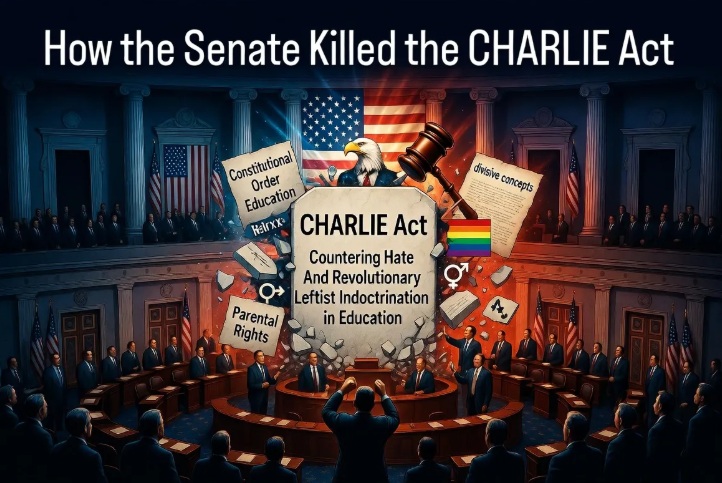
The CHARLIE Act was designed to enact paradigm change on public education for the better. On April 29, 2026, the Senate Education Committee gutted the CHARLIE Act. What had been introduced as the Countering Hate And Revolutionary Leftist Indoctrination in Education Act—a bill that named what it was prohibiting and grounded its authority in the constitutional order—was rewritten as a near-identical reissue of the 2021 “divisive concepts” statute that the judiciary already struck down.
The timing makes the capitulation worse. The Trump administration has spent the past year systematically dismantling the regime of district-court injunctions that activist judges used to choke off conservative governance. In Trump v. CASA, Inc. (June 2025), a 6-3 Supreme Court majority held that district courts lack statutory authority to issue nationwide injunctions. Of twenty-four emergency-docket cases involving challenges to Trump administration actions in 2025, the administration prevailed in twenty. The pattern is unambiguous: district courts in California, Maryland, and Massachusetts issue maximalist injunctions; appellate courts and the Supreme Court reverse them. The Senate amendment affirms this judicial overreach at the very moment it is losing its grip.
The political picture is equally clear. Seventy-eight percent of American parents oppose biological males in girls’ sports. Seventy-seven percent oppose mixed-sex bathrooms in schools. Eighty percent support parental notification on gender-identity content. These are 75–80/20 issues—the issues on which Trump won decisively in 2024 and on which the Republican coalition has been built since 2022. The Senate amendment, by enshrining “gender identity” and “sexual orientation” as protected statuses in the same statute that purports to prevent ideological capture of public schools, cedes that ground just as the fight is being won nationally.
I. The Foundational Error: Civil-Rights Framing
The original CHARLIE Act was crafted knowingly. It opened with a claim about the proper end of public education—“preparing students for productive citizenship”—and located its authority in the constitutional order. It named the prohibited pedagogies by name and lineage: Hegelian and Marxist dialectical analysis, Freire’s critical consciousness, Ladson-Billings’ culturally relevant pedagogy, Crenshaw’s intersectionality, critical race theory, critical legal theory. It explained why they are prohibited: because they promote purposeful division by framing society through lenses of inherent oppression, and because they cultivate a hostile or revolutionary disposition against the American founding. That is constitutional framing. It says: the people of New Hampshire have the authority to determine the civic ends of public education and to forbid public employees from using the state’s classrooms to undermine the constitutional order.
The Senate amendment throws all of this away. The amended title—“AN ACT relative to the prohibition on teaching discrimination”—is telling. The bill is no longer about civic formation of citizens. It is about discrimination. And because it is about discrimination, every prohibited belief must be rendered as a claim about inherent superiority or inferiority among symmetrically protected identity categories. Any framing in identity categories plays into the Left’s strengths. It is almost word for word the 2021 banned-concepts law that was struck down, and, believe it or not, it was likely to our great benefit that it was struck down.
The deeper problem is structural. Civil-rights anti-discrimination law is built on the principle of symmetrical, blind protection. It cannot, by its own internal logic, distinguish between teaching that celebrates the American founding and teaching that condemns it as a settler-colonial project. Civil Rights law is a foundation of shifting sand not suited for any education reform effort from the Right.
II. The Myth of Neutral Education
Having abandoned constitutional republican ground of natural rights, the Senate reaches for a substitute principle: neutrality. The amendment requires educators to provide instruction “without endorsement” through a “factual, objective” lens. Then, two subsections later, the same bill demands that educators “teach civic education in a manner that cultivates a neutral or patriotic disposition”—a phrase borrowed from the original CHARLIE Act. These two requirements cannot both be true. Cultivating a patriotic disposition is endorsement—endorsement of the American founding, of the constitutional order, of the transcendent principles of inherent rights. If instruction must be “without endorsement,” patriotism cannot be cultivated.
There is no such thing as neutral education. Every act of teaching presupposes some account of what is true, what is good, and what kind of human being the student should become. Curriculum itself—the very fact that thirteen years of compulsory schooling are spent on these things and not those—is a value judgment of staggering weight. To pretend otherwise is not to achieve neutrality but to conceal the values that are operating, which makes them harder to examine and harder to challenge.
Worse, “neutrality” as a regulative ideal favors whoever controls the framing of what counts as neutral. In every American educational institution of the last forty years, that has been the side that treats progressive premises as the unmarked default and traditional or patriotic premises as the marked, ideological, contestable view. A teacher framing American history through Howard Zinn can credibly claim to be presenting the “factual, objective” account. A teacher framing it through the Federalist Papers must constantly disclose that he is offering a particular viewpoint. The Senate’s neutrality requirement ratifies this paradigm.
There is also a creed problem. The bill’s protected categories include “creed” alongside race and color. A creed is a system of belief—a worldview, a confessional commitment, a set of held convictions about how one ought to live. “All men are created equal, endowed by their Creator with certain unalienable rights” is a creed. Communism is a creed. Sharia Law is a creed. Fascism is a creed. These are not interchangeable. They make rival, mutually exclusive claims about the nature of reality. A statute that forbids teaching that one creed is “inherently superior” to another has boxed out patriotic education and enabled radical relativism. It has staked out the position that all creeds are morally and pedagogically equivalent. Under the literal text of the amended statute, a New Hampshire teacher cannot purposefully teach that constitutional republicanism is inherently superior to Marxism-Leninism, or that the founders’ understanding of natural rights is preferable to Sharia law. A statute cannot demand patriotism and creedal neutrality simultaneously. The Senate amendment demands both.
III. What the Original Bill Got Right
The original CHARLIE Act identified prohibited pedagogies by name and lineage rather than by attempting to define every possible prohibited act. Every one of those names—Freire’s critical pedagogy, Ladson-Billings’ culturally relevant pedagogy, Crenshaw’s intersectionality, critical race theory—is a term of art in the field of education, taught in graduate schools, cited in peer-reviewed journals, named explicitly on syllabi. Every working teacher and administrator with a master’s degree knows what these terms mean. The litigation strategy that asks federal courts to declare such terms incomprehensible is a legal performance within the framework of critical legal theory itself, not a serious epistemic claim. Naming the prohibited frameworks by name gave educators precise notice and gave courts a manageable interpretive task. If such a thing is impossible, then the Constitution itself is likewise incomprehensible—we know that is a cop-out.
The original bill also drew the line at the right level. It did not enumerate protected identity classes because it was not anti-discrimination legislation. It was civic-formation legislation. It identified pedagogies, not statuses. That formulation could be enacted alongside parental-rights, sex-segregated-facilities, and women’s-sports legislation without contradiction, because all of those bills share its underlying premises about biological reality, parental authority, and contested ideological claims. The amended bill cannot. If it passes, it will be cited—immediately and predictably—as legislative authority for the proposition that New Hampshire recognizes “gender identity” as a protected status equivalent to race and sex—exactly a policy the Biden administration attempted to read into Civil Rights law that SCOTUS just rejected. Plaintiffs in every future Republican-priority bill in this area will quote it as black-letter state policy. Bills segregating bathrooms and locker rooms by sex may not survive next to this Senate bill. The amendment is not only self-defeating—it is perpetually defeating of future policy.
IV. The Enforcement Catastrophe
The Senate amendment’s enforcement regime is not merely weaker than the original CHARLIE Act. It is weaker than the 2021 divisive concepts law that generated zero meaningful enforcement actions in three years of operation—the very statute the Senate is ostensibly trying to improve upon.
The 2021 divisive concepts law provided a civil action against the school or district, a remedy through the New Hampshire Commission for Human Rights, and a code of conduct violation—none requiring proof of intent, but only commission. The original CHARLIE Act provided a private right of action with $10,000 in compensatory damages per violation plus attorney fees, a code of conduct violation up to and including certification revocation, and an explicit legislative finding that employment in public education is a privilege funded by taxpayers, not a right. The Senate amendment provides a code of conduct sanction only—and nothing else. Both civil remedies from both prior statutes are gone.
The remaining code of conduct sanction is triggered only by purposeful violations—which is the wrong frame entirely. When government itself is inflicting harms upon children and families the fact of the offense, and not the mysterious heart-feelings of the offender, are what matters. A child subjected to Freirean critical consciousness exercises has been harmed regardless of whether the teacher harbored conscious ideological intent. The professional education establishment operates precisely by training teachers to execute a curriculum; the intent is baked into the pedagogy itself, upstream of any individual classroom. Requiring proof of purposeful discrimination collapses the entire enforcement mechanism rendering the whole bill worse than meaningless—a pseudo-solution to campaign on.
V. The Larger Surrender
The Trump administration is in the middle of the most aggressive judicial defense of executive authority in modern history, and is winning. Trump v. CASA invalidated the nationwide-injunction tool. The Department of Justice is suing states that allow biological males in girls’ sports under Title IX. Cabinet departments are rescinding gender-identity and DEI guidance. Major medical institutions are quietly revising pediatric gender-affirming-care protocols—the United Kingdom’s Cass Review, Sweden’s Karolinska, Finland’s national protocols have already pulled back on the basis of the underlying evidence. The 2024 election was a referendum on these issues, and the result was unambiguous in favor of Republican policy.
Into this moment the New Hampshire Senate has chosen to introduce an amendment that retreats, roughly, to the Democratic position circa 2010. It is an abandonment of the party platform and a capitulation on 80/20 polling issues in our favor. It is a position that would have been considered defensive even in 2018, before Bostock, before the Loudoun County protests, before the Cass Review, before the 2024 election, before Trump v. CASA. It is the legislative equivalent of winning the castle in a siege only to then abandon the castle to take up residence in the surrounding woods to play Robin Hood.
Further, the endorsement of the lower-court decision on this matter not only cedes the policy win to Democrats, it reinforces the very usurpation of legislative authority that has stifled conservative government for generations.
This pattern of substituting strong constitutional foundations for weak civil-rights ones is not accidental. It is the predictable output of a conservative legislative apparatus colonized at the staff and consulting level by organizations formed inside the paradigm that forecloses any possibility of conservative victory. They substitute constitutional ground for discrimination law because that is the only ground they know in a Civil-Rights regime that has reigned in place of our constitution for decades. It’s another cycle of fuel for the demoralization engine, and precisely the outcome driven by Ayotte’s DOJ and their Civil Rights division who showed up to malign the bill.
The path forward is not to defend the amendment. It is not even to refine it. It is to recognize that it was conceived in a posture of defeat that the underlying facts do not warrant, and to return to the ground the original bill staked out: that public education is a formative enterprise; that the people of New Hampshire are entitled to determine what that formation aims at; that the constitutional order is the proper aim; that pedagogies designed to delegitimize that order have no claim on the state’s classrooms or the state’s payroll; and that the proper response to a district court ruling that contradicts these premises is to make the better argument on appeal, and even to consider impeachment of rogue judges, not to rewrite the legislative agenda to match the ruling.
The unfortunate reality is that the Senate’s position is so far to the Left that it represents what would have been considered radical by Democrats just thirty years ago—it represents a significant worsening of even the poor status quo. At present it does not appear that the positions are reconcilable, nor that further negotiation on this issue can be undertaken without a real risk of making things worse in NH law. As such, it is my regrettable advice that the bill, as amended, should be rejected outright by the GOP House. Kill it dead and send a message that we won’t negotiate on terms rigged to defeat conservative policy. Sometimes in iterated games theory is it more beneficial to lose a round badly than lose by a small increment. I am hopeful we can try again in the future.
Authors’ and Speakers’ opinions are their own and may not represent those of Grok Media, LLC, GraniteGrok.com, its sponsors, readers, authors, or advertisers.
Disagree, agree, Got Something to Say, We Want to Hear It. Comment or submit Op-Eds to steve@granitegrok.com
