
The black box redactions on Nashua’s Performing Arts Center legal invoices were not a mistake. They were reviewed and approved by the City’s Legal Office.
When I wrote last week about Nashua’s “Epstein-style” redactions, I left open the possibility that the City might claim error. Maybe someone inexperienced had over-redacted. Maybe a clerk panicked. Maybe there was no oversight.
Those $33,000 in legal invoices were returned to the public with every narrative description erased, solid black rectangles where explanations of taxpayer-funded work should have been. It looked outrageous and deliberate. But it might possibly be simple incompetence.
The City’s March 3 response removes that possibility.
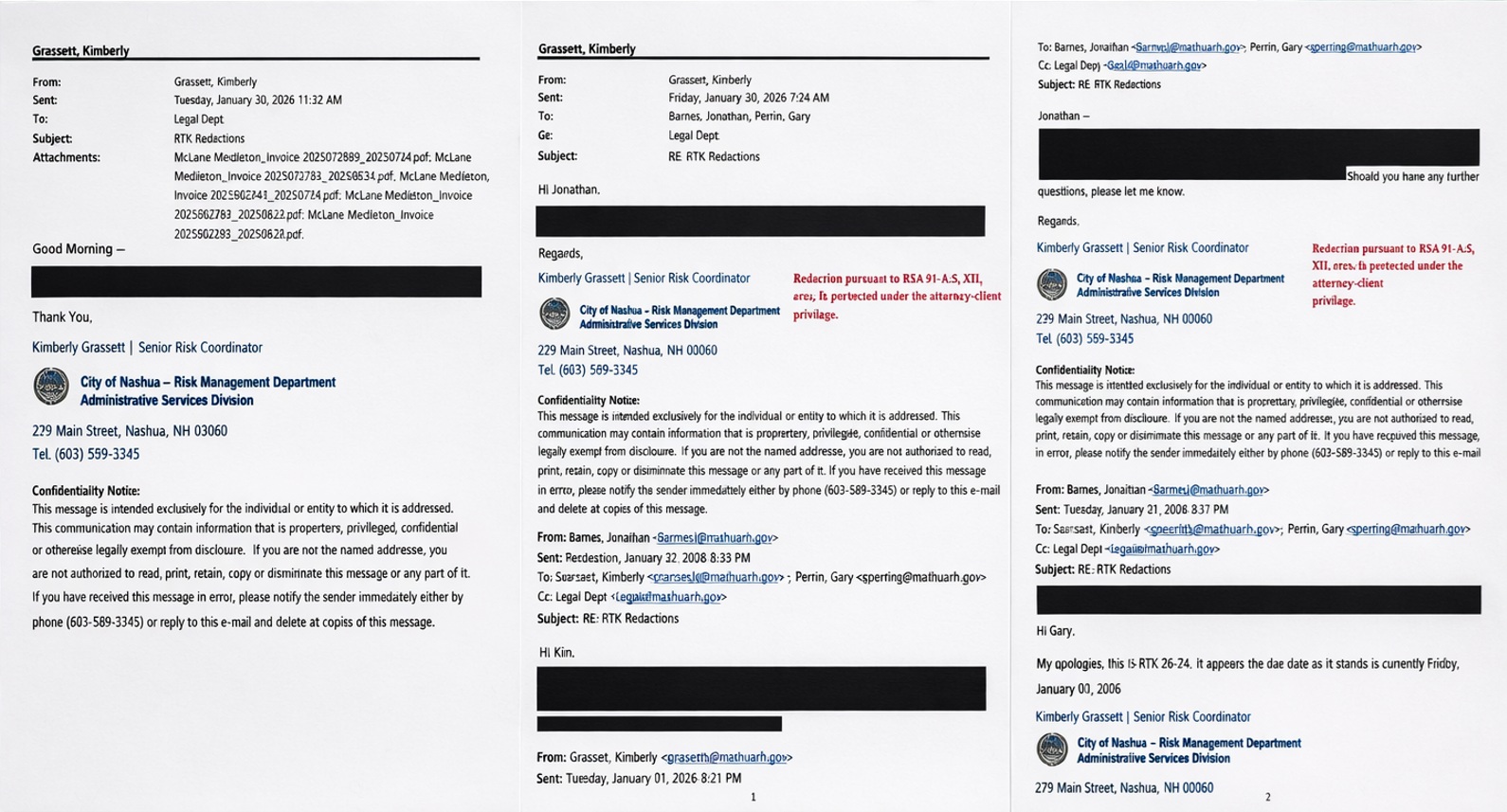
The newly released internal email chain shows the redactions were not handled by a junior employee acting alone. They were managed by a Senior Risk Coordinator with extensive experience in redactions and were circulated directly to the Legal Department, including Attorney Bolton, Attorney Leonard, Attorney Barnes, and Records Administrator Gary Perrin. The subject line of the exchange was “RTK Redactions.” Invoices were forwarded to Legal. Legal was looped in. References to RSA 91-A:5, XII, attorney-client privilege, were expressly cited. There were multiple exchanges before the invoices were released. [Related: ORTOLANO: The Black Box Defense – Epstein-Style Redactions on Nashua’s Arts Center Legal Bills]
This was no accident. It was reviewed, discussed, and approved.
And what is redacted in those emails? The substance of how the redactions were handled. Once again, under attorney-client privilege.
The “mistake” narrative is no longer credible. If Legal reviewed the invoices before release, and the emails show they did, then Nashua’s Legal Office knowingly approved invoices that had every description of legal work erased without providing any exemption at all. That is no longer clerical error. That is policy.
Under New Hampshire’s Right-to-Know law, redactions must be narrowly tailored. What the law does not permit is the wholesale removal of every narrative entry across nine pages. Nor does it allow a public body to simply stamp “RSA 91-A:5, XII” on a page and declare the request satisfied. In this case, there was no stamp on any page. Exemptions must be applied specifically and defensibly. A blanket blackout of all descriptions is neither narrow nor specific.
My request was filed on January 13, 2026. The City now says it needs until March 10, 2026 to decide what to do.
For five years, Nashua’s Legal Office, under Attorney Bolton’s leadership, has mishandled Right-to-Know requests involving these entities and other matters. Responses are delayed. Exemptions are vaguely cited. Redactions are overbroad. Requests are closed without adequate searches and explanation. At some point repetition ceases to be oversight. It becomes either unacceptable incompetence or deliberate obstruction. There is no third category.
The March 3 emails are particularly revealing because they show coordination. Risk Management did not act in isolation. Legal was consulted. Legal was copied. Legal approved. That means the City’s lawyers signed off on redactions that eliminated every description of work performed.
The pattern is as troubling as the redactions themselves. Citizens who challenge these practices are forced into prolonged court proceedings. By the time a judge rules, the money has already been spent, the records have already been withheld, and the conduct has already occurred. Delay becomes the defense. Stall long enough, and the citizen becomes the problem.
Sunshine Week is approaching, the annual celebration of open government. In Nashua, taxpayers are staring at six figures in legal bills, three shell corporations, taxpayer-funded outside counsel, and now documented Legal Department approval of blanket redactions. The City has treated attorney-client privilege as a magic wand, invoking it to make transparency disappear.
The most telling question is the simplest one: If the descriptions of legal work are so sensitive that every word must be erased, what exactly did taxpayers pay for?
After the March 3 disclosure, one thing is no longer debatable. The black boxes on those invoices were not the product of a careless employee or an overzealous clerk. They were reviewed, discussed, and approved inside Nashua’s Legal Office.
And that raises a larger question for Sunshine Week: if the City’s lawyers believe taxpayers cannot see what their money paid for, who exactly do they think City Hall works for?