

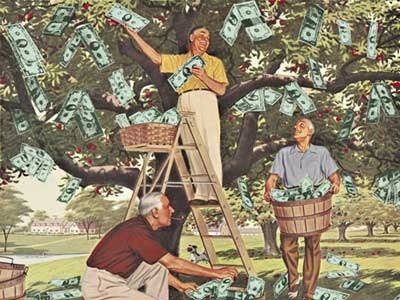
I’ll be the first to admit it. I’m a simple-minded person.
That doesn’t mean I’m ignorant or stupid. It means I tend to see things in a basic, no-nonsense way. When I first started paying attention to local government, one phrase on town warrant articles immediately confused me.
“NOT TO BE RAISED THROUGH TAXATION.”
I saw it over and over again on special warrant articles, and I kept asking myself a very simple question.
If you’re not taxing me to buy this thing, where did the money come from?
Had New Hampshire towns somehow pulled off a miracle in horticulture and selectively bred the mythical Money Tree? One can dream.
The simplest explanation, and usually the correct one, is this:
It’s last year’s leftover taxes.
When towns present “not to be raised through taxation” warrant articles on Town Meeting Day, what they are really saying is this: instead of giving back money that was over-collected or underspent, they would like to keep it and use it for something else.
Every year, towns collect revenue from many sources, including grants, fees, and reimbursements. But by far the largest chunk comes from property taxes. In Goffstown, roughly 88 percent of total revenue comes from property tax collection.
At the end of the year, when a town collects more than it spends, that excess money goes into what’s called the Unassigned Fund Balance (UFB). New Hampshire provides guidance on how much towns should retain, generally between 6 percent and 16 percent, and there are only three legal uses for that money.
1. Emergency situations
2. Special warrant articles approved by voters
3. Offsetting the following year’s tax rate
When I started digging into Goffstown’s finances, I found something troubling. Over the past decade, the Select Board has chosen to use unassigned fund balance to offset the tax rate only four times.
Since 2016, an accumulation of roughly $28 million worth of policy decisions has flowed through Goffstown’s unassigned fund balance. Some of that spending was warranted. Some of it, in my opinion, was not. But out of all that money, only about $2 million was ever used to reduce the tax burden on residents.
To make matters worse, we even have Select Board members on record openly stating that they would like to move away from using unassigned fund balance to offset taxes in the future.
Many New Hampshire residents feel like the ship is taking on water and all the lifeboats are already gone. So what are we supposed to do?
This year, I decided to use New Hampshire law exactly as intended and submitted a citizen petition warrant article to cap the amount of unassigned fund balance Goffstown can hold. Any excess above that cap would automatically be used to offset the following year’s tax rate.
I’m under no illusion that this will make me popular with the town’s biggest spenders. But when families are sitting at their kitchen tables realizing they can no longer afford to stay in what was supposed to be their forever home, maintaining the status quo stops being an acceptable answer.
I researched surrounding towns and communities similar in size to Goffstown. Most maintain unassigned fund balance policies in the **8 to 10 percent range**, well within state guidance, while still meeting their obligations and preparing for emergencies.
At deliberative session, I fully expect to hear arguments rooted in fear.
-This will prevent the town from paying its bills.
-This will jeopardize contracts and future projects.
-This will be impossible to manage.
That’s where learning the difference between **fact** and **feeling** matters.
FACT: Encumbered funds are not part of this equation. New Hampshire law already ensures towns must pay their bills and honor contractual obligations.
FACT: Projects already approved by voters are protected.
FACT: Town employees will still receive their paychecks.
FEELING: This will be difficult for towns to manage.
But towns are already managing this money. This proposal simply makes the next step automatic and transparent. Give it back.
Using Goffstown’s own MS-535 forms submitted to the Department of Revenue Administration, I ran a hypothetical scenario. What if this cap had been in place over the last ten years?
The result:
This does not mean there was ever $28 million sitting in a vault.
It means that, year after year, taxpayers were denied relief.
Over time, those decisions add up to $28,263,709 that could have been used to offset local property taxes instead of being retained.
Let me repeat that for the people in the back.
Twenty-eight million, two hundred sixty-three thousand, seven hundred and nine dollars.
That number made me angry. Not because I dislike my town, but because I love it. Home sales in Goffstown doubled this past October and November compared to the year before. How many families left because they simply couldn’t afford it anymore? How many might still be here if even half of leftover UFB money had been returned to taxpayers?
Once money is collected, it’s nearly impossible to claw back. But the guardrails I’m asking voters to approve ensure that excess money automatically returns to residents while still allowing our town to plan responsibly for emergencies and important needs.
That’s not radical. It’s responsible.
If you live in Goffstown, please show up.
February 2 and 3 for the school and town deliberative sessions
March 10 on Town Meeting Day
This only works if citizens are willing to participate.
We can rein in runaway spending. We do have the power.
But only if we’re willing to show up and use it.
Authors’ and Speakers’ opinions are their own and may not represent those of Grok Media, LLC, GraniteGrok.com, its sponsors, readers, authors, or advertisers.
Disagree, agree, Got Something to Say, We Want to Hear It. Comment or submit Op-Eds to steve@granitegrok.com
