

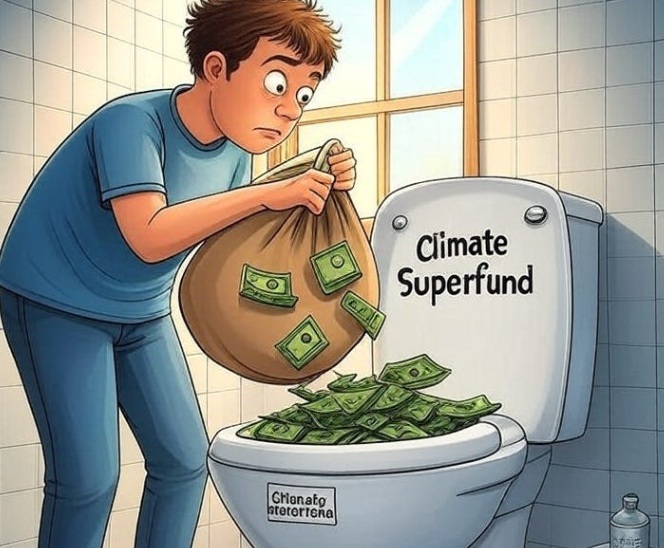
Cue up the sad violins. On August 6, 2025, South Carolina Judge Roger Young dealt the latest blow to the shakedown scheme masquerading as climate justice popularly known as “Make Big Oil Pay” and officially, in Vermont at least, as the Climate Superfund Act. In another example of fraudulent misnaming by lawmakers, it is neither super nor will it ever contain funds.
The idea behind the so-called Superfund, just to remind the reader, is that Vermont (along with other states and municipalities) will present a bunch of fossil fuel producers with a massive bill for all the damage allegedly caused by climate change and Exxon Mobil et al will just cut us a check. Or not. And, not surprisingly, the “or not” option is the one the fossil fuel companies are choosing, instead taking their chances in court. Where….
Judge Young dismissed the “Make Big Oil Pay” case brought by the city of Charleston, South Carolina, “with prejudice.” A legal term colloquially equivalent to “get the [heck] out of my courtroom with all your [baloney] and don’t come back.”
He’s not alone. In his forty-five page opinion, the Judge noted,
This Court thus joins the ‘growing chorus of state and federal courts across the United States, singing from the same hymnal, in concluding that the claims raised by [climate-change plaintiffs] are not judiciable by any state court” and that “our federal structure does not allow . . . any State’s law to address [these types of climate-change] claims.”
The chorus refers to similar cases dismissed in Maryland, Pennsylvania, New York, Delaware and New Jersey based on the legal reality that states and municipalities do not – cannot — have standing to bring these suits.
The question before us is whether municipalities may utilize state tort law to hold multinational oil companies liable for the damages caused by global greenhouse gas emissions. Given the nature of the harm and the existence of a complex web of federal and international environmental law regulating such emissions, we hold that the answer is “no.”…
Because all of Plaintiff’s claims are precluded and preempted by the federal Constitution and federal law…
There’s that pesky Constitution again! The bane of the Left!
But Judge Young made some other observations about the climate warriors’ case that are worth mentioning both for information’s and entertainment’s sake. A key takedown being the attempt to compare these greenhouse gas cases to tobacco-type settlements, an argument the plaintiffs heavily hang their hats on. It’s an argument we heard a lot in Vermont to justify passing our Superfund Act. Nope.
A plaintiff smoking tobacco in South Carolina causes direct adverse health effects to that plaintiff in South Carolina. The City’s claims, by contrast, depend on interstate and international emissions allegedly causing global climate change, ultimately resulting in alleged in-state injuries caused by, for example, the weather. Because any alleged injury under Plaintiff’s claims necessarily relies on the cumulative effect of interstate and international emissions from global consumers, the claims are readily distinguishable from these other mass-tort cases and are uniquely precluded and preempted by federal law.
Insert loud Family Feud “X” sound effect here. Judge Young’s decision points out just how ridiculous a precedent a ruling in favor of the plaintiffs would be and the chaos it would lead to.
If all 50 states, let alone the tens of thousands of political subdivisions therein, were permitted to apply their own laws to such federal issues as interstate and international emissions, the result would be conflicting state standards that would be impossible for energy companies to navigate — what the U.S. Supreme Court called a “chaotic confrontation between sovereign states.”
And the hilarious part, emphasis added:
Under Plaintiff’s theory, any emitters of or contributors to greenhouse gas emissions— such as airlines, automotive manufacturers, power companies, and agricultural companies—could be liable for contributing to global climate change unless they adequately (according to Plaintiff’s standards) warned consumers of the climate-related risks of using their products. That would appear to include even the Plaintiffs in this and other climate-change lawsuits, since they have long used and continue to use fossil fuels for myriad purposes—and built and maintained nearly all the roads and bridges that make fossil-fuel-powered transportation possible—despite their admitted knowledge of the potential climate-change consequences of their actions.
Yes! And thank you, Judge Young, for saying it on the record to these flaming, hypocritical bottom feeders.
All that said, the key takeaway here is that these lawsuits are not viable. Boondoggles. Wastes of time and – as usual – taxpayer money. The Vermont legislature has blown/is blowing nearly a million dollars on this scam to nowhere in FYs 2025 ($600K) and 2026 ($350K). That’s not including the cost to defend the counter suit the oil companies brought in response, and it looks like they’ll win.
In closing, I’ll just say if you’ve been suckered into donating to VPIRG or some similar organization to fund support for this nonsense, consider this you’re official notice that you’ve been ripped off. Maybe our Attorney General will take your case! Oh, wait….
