

Two polls were released within the last week: one by the University of New Hampshire (The Green Mountain State Poll), and more recently one by Vermont Public (yes, I caved and used the new dumb name). The former caused shock waves by concluding that the far-left activist Amanda Janoo is beating America’s most popular governor by 6 points, 49-43, while the latter showed Phil Scott with a “statistically significant” 10-point lead of 44-34 among likely voters. What to make of this?
Vermont Republicans should take the polls seriously. Both show Scott with roughly the same amount of support: 43 percent and 44 percent respectively. That is obviously less than 50 percent and, electorally speaking, not good. The difference between the two polls is in the number of undecided voters, 6 percent versus 16 percent, with – assuming Scott’s 43/44 percent is solid – the majority of VPR’s undecideds breaking 9 to 1 for Janoo in the UNH polling. I mean… could be…. And if Scott really is in jeopardy of losing this election to a Mamdani-adjacent Democratic Socialist, we are all well and truly screwed.
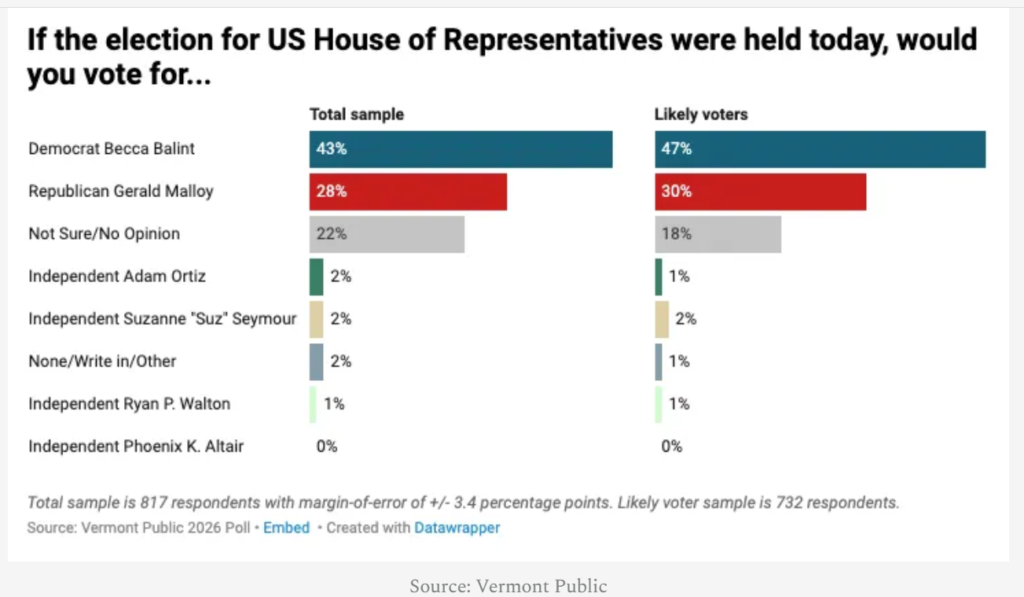
But interestingly – a point that seems to have been largely ignored by the establishment media — the VP-no-longer-R poll also shows U.S. Congresswoman Becca Balint (D-VT) of the Progressive Caucus, who is a poster child for screeching Trump Derangement Syndrome, polling just as badly as Scott at 47 percent among likely voters and 43 percent among all voters. Her opponent, Republican Gerald Malloy, trails by 17 points with 18 percent undecided, but still… 43 percent.
Again, the issue between the two polls in this race is the undecided factor. Malloy pulls in at exactly 30 percent in both polls, but Balint gets 66 percent in the UNH poll with just three percent undecided.
So…. Is Vermont Public accurate in showing that 20 percent-ish of Vermont voters are undecided at this point in the election? Is UNH accurate in showing only 3 to 6 percent are undecided – and virtually all of those undecideds have, well, decided to vote Democrat?
The beef the Scott team has with the UNH poll is that it oversamples Democrats. If the UNH team substituted partisan Democrats for independents in its pool, the lack of undecideds makes sense. In this polarized environment, party-affiliated voters have made up their minds to support the letter beside the name. Vote Blue No Matter Who! Independents tend to make up their minds later in the process and ultimately don’t (usually) all break one way.
Who do I think is right? Honestly, I don’t know. My children will not be used as betting collateral this year. But I did think that this line from the story accompanying the Vermont Public poll was telling. The piece, as you would expect, is a boot-licking propaganda piece for Janoo, but the last line is a quote from Natalie Silver, Becca Balint’s 2022 campaign manager:
Even if he [Scott] wins on Nov. 3, Silver said, his sixth term will be far more tenuous if he can’t replicate those margins of victory this year.
“I would say that if she [Janoo] comes within 10 points,” Silver said, “that is a sign that it is open season.”
The implication from the Democrat political strategist—who I speculate is seeing more private polling data than the rest of us shlubs in the public are privy to—is that Janoo will lose, but by a ten-point margin. That is how they will define “victory.”
Side note to the VP reporter Peter Hirschfeld, who wrote the story: Hey Peter, why, with Balint’s former campaign manager on the phone, didn’t you ask her what she thought of Balint’s 43 percent showing with all voters? Is it possible that her constant hyper-partisanship is also turning off Vermonters? Isn’t her 43 percent just as big a story as Scott’s 42 percent? I guess not. Move along. Nothing to see here….
And I suspect the reason for that journalistic “oversight” is that, again with the salt-sprinkled caveat if the poll is accurate, the takeaway should be that the total data picture is showing not the “Democrats coming home” moment that the toady media is desperately trying to frame this election with so much as generally anti-incumbent mood throughout the state – a non-partisan, pox-on-all-of-you desire for change. I mean… could be….
The most important thing here is: what does this mean for down-ticket races? Republicans have a chance to take control of the state Senate for the first time in thirty years. They have a pretty good plan, the Vermont Promise, to start tackling key issues that can improve the affordability of Vermont. They and their House candidate colleagues need to get out of the shadow of Phil Scott and show Vermonters their own fresh brand of policy leadership because the bloom may or may not be entirely off that rose, but by all indications it is fading.
One final note of interest – perhaps the most interesting part of the VP poll. The pollsters screwed up the question regarding the LTG race, referring to Molly Gray originally as a Democrat/Progressive. As such, she pulled in just 38.8 percent, a statistical dead heat with John Rodgers. When the pollsters fixed the error and referred to Gray as just a Democrat, her number shot up to 45.6 percent. This doesn’t say much for the Progressive brand! But it does provide Republican candidates with some excellent free message testing. Finally, something useful for our tax dollars!
