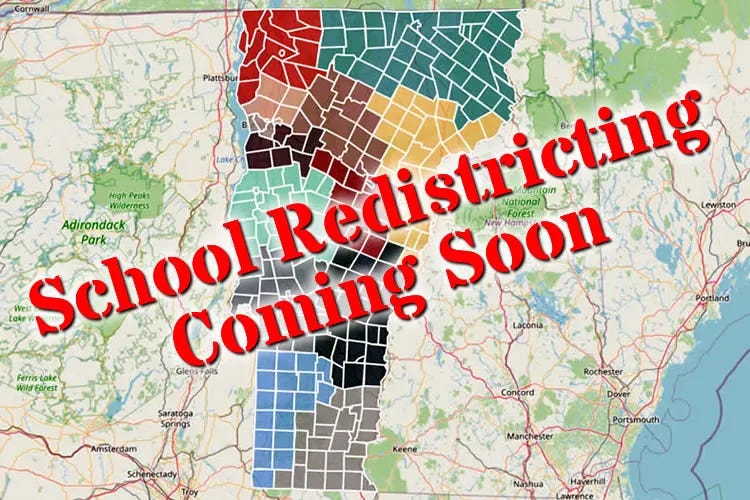
The Vermont School District Redistricting Task Force met for the first time on August 1st. I’ve been checking the Agency of Administration’s web page for the group, hoping they’ll post the meeting recording or at least the minutes for review. So far, no good. But they did post the agenda (no actual work involved; just a meet and greet and background presentation), and in that agenda is a link to the mapping program, School District Builder, that they will use to complete their task.
Clicking on that link was a PTSD moment for me as a former (I guess current, as the term lasts ten years) member of the Legislative Apportionment Board (LAB) responsible for making recommendations regarding updates to house and senate district maps following the 2020 census. A Vermont Public article covering the Task Force meeting quoted Rep. Rebecca Holcomb (D-Norwich) as saying, “It’s pretty clear we are not capable of doing what we already have on our plate.” To which I can only respond, ahhhhhh-yup.
The LAB held our first meeting in September 2020, nearly fourteen months before we were required to present a (one) recommended house and a (one) recommended senate map to the legislature for consideration. And, while unexpected delays in getting final census numbers unproductively ate up a bunch of time, we needed every minute to complete the job. This new Task Force is supposed to come up with three different maps in roughly five months, two of which contain Thanksgiving and Christmas. They have not even scheduled their second meeting yet. I do not see this going well.
Granted, after the Democrat majority in the legislature took the LAB’s year-plus worth of tri-partisan legislative redistricting work and threw it in the trash, they were able to whip up in about three months their own gerrymandered schemes to ensure their own supermajorities in 2023-4. But, call me cynical, I think those maps were in the making long before they got any input from us. It’s not as encouraging a comparison as it might seem on the surface.
Moreover, and not to diminish the complexity of redrawing legislative lines, this school district thing appears more – possibly much more — complicated. Both politically and logistically.
Sadly, nobody who’s not a political junkie really pays much attention to legislative district lines and the debates surrounding them, so there wasn’t a whole lot of public politics involved with the changes we were proposing. That will not be the case with these school district maps. Parents, students, teachers, and property taxpayers will, putting it mildly, have opinions.
Not to mention, the constitution mandates that legislative districts be updated every ten years to reflect population changes, so there was no political debate over whether or not we on the LAB needed to be doing what we were doing. Again: not the case with school district redistricting. This is, legally speaking and medically metaphoring, elective surgery, and there are already people questioning the need or value of going under this particular knife. The law itself isn’t even sure, as it contains a “kill-switch” on consolidation if the legislature can’t agree on a final map.
Working toward that inglorious end, VT Digger just reported on a group of Northeast Kingdom school officials who are working to ensure that the kill switch gets flipped. According to the article, one of the organizers, John Castle of the North Country Supervisory Union, said, “There’s a strong possibility that the whole thing just goes away…. [T]here’s a part of me that feels like we should be the biggest pain we possibly can be, and join others in the state to be a real pain, to see the whole thing go away.” Ohhh boy.
I’ve got to tell you, if Polymarket decides to open betting on this issue, I’m putting a tidy sum on John Castle and crew. Why? There are too many immediate negatives that come with this plan beyond a slapdash map-making process – school closures, long bus rides, loss of local school boards, no more citizen voting on school budgets, lost school choice – that opponents can use to beat this proposal to death, and not enough, if any, immediate or short-term tangible benefits voters can get excited about. Even potential long-term benefits aren’t guaranteed and, if they materialize at all, will be too little too late.
So why is this a problem, particularly for Republicans?
First, this popular resistance to the idea is starting in the Northeast Kingdom, where Republicans picked up two Senate seats and a couple of House seats last election. Beyond the Kingdom, objections are coming primarily from rural districts, which tend to lean Republican and where many freshman Republicans will be running for re-election for the first time next November.
Second, this law was based on a plan put forward by the Republican governor, with a bill sponsored by Republican leadership, and passed with more Republican than Democrat votes in the Senate (there was no roll call in the House, but…), so they pretty much own this. They own it, but don’t control it. The majority of Democrats have the votes to decide this law’s ultimate fate, have no incentive to help Republicans get a win or minimize fallout in the event of a loss, and – rallying behind those rural resistance groups being “real pains” — have every incentive to just kill it solidarity with those grassroots opposition movements, making inroads in Republican districts. It’s an odd box Republicans chose to put themselves in, to say the least, but here we are.
Lastly, Republicans picked up a historic number of seats last year running on property tax relief, and this is their plan to deal with that (such as it is). If it fails due to a lack of popular support or, worse, aggressive public hostility, it’s clear that doesn’t help them win future elections.
So, back to the headline of this post, Republicans better have a Plan B on property taxes to bring to the voters for November 2026. You’d better start working on it now. You’d better put it forward during the 2026 session because you’re going to need it for the 2026 election. The Democrats will undoubtedly have one. And again, if Polymarket is listening, I’ll put money down that plan will be property tax relief via a shift to the income tax. Not good. But a frustrated Vermont public with no other alternative might very well go for it, as well as the party promising it.