

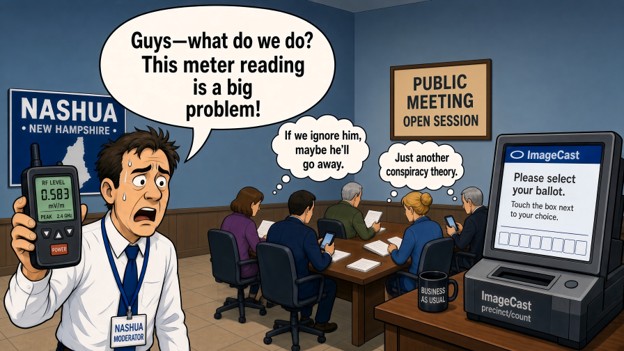
This isn’t a conspiracy. Facts don’t lie.
On 8 September, during the primary, a Nashua Ward 9 moderator held a radio-frequency meter next to an ImageCast voting machine. The meter detects cellular, Wi-Fi, and radio activity. The radio number registered. The electric and magnetic rows stayed at zero, so it was not a motor despite 2 nervous voting machine companies trying to dismiss it in the media as electromagnetic frequency. City and Concord officials were told. Thirty-four days later, no one has called the moderator back or taken any action.
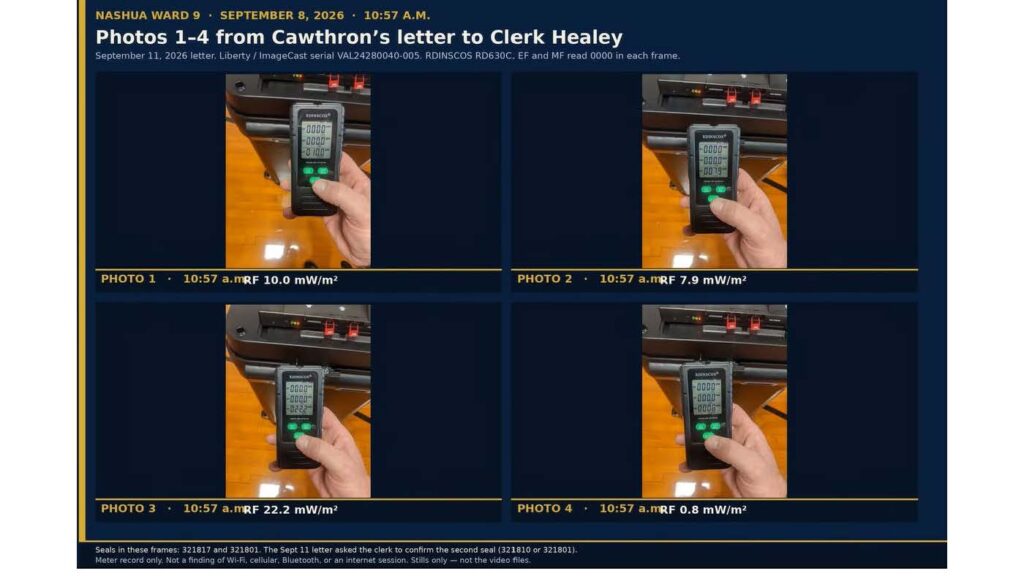
That is a meter record from election day. It is not proof the machine was on the internet. No one can say it was not. And once you look past that one machine, the problem gets bigger.
New Hampshire law is clear on the basics. A voting machine shall not have access to the internet, and shall not be connected to it (RSA 656:42, X). If a part is altered, the Ballot Law Commission has to approve the device again before it is used (RSA 656:41). We are heading into the midterms, and right now we cannot confirm either of those things. Two hundred and nine jurisdictions use these machines. 96% of the names on the checklist live in those towns and wards.
In 2023, the Ballot Law Commission approved two types of machines: Liberty/Dominion ImageCast and VotingWorks. Both count your votes from a photograph of the ballot. The voter marks the oval. The camera takes the picture. The instructions on the scanner tell the camera what to send. The computer turns that picture into the totals. The moderator signs the tape. The path from the ballot to the tape is sealed from review, and no town can read the software that runs on election day.
We are casting ballots into a black box with no way to tell what is in there. The pictures themselves are not public (RSA 656:42, IX). The Commission’s approval did not include an examination of a single machine that was delivered to a town. The federal lab test the Election Assistance Commission uses does not check these things either, and that is a test of a sample the vendor selected. Certification is simply a participation trophy and does little to protect voters.
It gets worse as you dig. The ImageCast user manual describes a wireless modem and a port for transmitting results. It does not limit what that modem can do. A cellphone does not need a port to access the internet, so a voting machine doesn’t either. Do the machines in our towns have this? No one knows. The software and the memory-card coding are proprietary, which means no one examined the machine in the town, nor can they.
VotingWorks named Custom America as its scanner in the 2023 proposal the Commission approved. The later parts list names a PageScan 6. The same list says the computer board is made in Taiwan. Are we using the approved machine? No one has opened an acquired unit to look.
For the record, a test that counts ovals is not this check. An audit of less than 4% of our machines by another unexamined scanner is not this check. That is all the state has offered so far.
This debacle now sits with the towns and cities in over 209 jurisdictions. The towns bought ~$ 3 million of Ballot Law Commission-approved models. The towns signed contracts with vendors that include no scanner name, no modem finding, no materials list, no internet statement, and no right for the town to open the unit and check it. Towns are on the hook by law to ensure their voting machine before any election is the approved model and cannot access the internet. A contract does not repeal the law so what happens to that huge investment and will the money stop our leaders from fixing this huge mess? The midterms are next.
The urgency to fix this is even higher with RF readings raising the very real possibility every town and city has exposed its voters through this process. The Ballot Law Commission was noticed on 17 September. Every machine town was noticed on 23 September and again on 29 September. The Governor, the Attorney General, the Secretary of State, and both election-law committees were noticed. No town has answered the 23 September notice. No response on the issue from any other office.
Citizens and candidates will not accept silence; a formal complaint was filed with the Attorney General. It would be a tragic outcome for New Hampshire, which also holds the prestigious “First in the Nation” status, to have its statewide elections possibly disqualified/ challenged because all those who have a duty to act failed us.
Brenda Towne and Al Brandano
New Hampshire Voter Integrity Group
Disclaimer: This commentary is not legal advice. It is not an accusation of a crime. It is not a finding that any result was changed, that malware is present, that a machine reached the internet, or that scanner instructions were altered. It is drawn from public records, Commission writings, vendor manuals, and contracts towns produced. We are acting per Part I, Articles 8, 32, and 38 of the NH Constitution.
Next meeting: Monday, October 19th – 10 am. Ballot Law Commission Meeting. Achieve building.
Authors’ and Speakers’ opinions are their own and may not represent those of Grok Media, LLC, GraniteGrok.com, its sponsors, readers, authors, or advertisers.
Disagree, agree, Got Something to say? We Want to Hear It. Comment or submit Op-Eds to steve@granitegrok.com
