

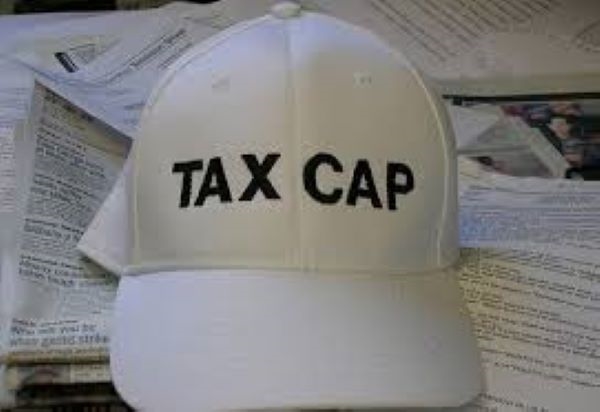
A statewide Tax Cap Question is on the November 3rd election ballot in the wards and towns of New Hampshire. You may not have heard about it amid all the electioneering on the airwaves! It is Question #2 (HB 1300). Two reputable, independent, tax-friendly NH organizations are providing information to help voters fully understand this Tax Cap Question.
Many schools already have signs near their properties telling voters to “Vote No on Question #2…the school budget cap.”
As parents are dropping off/picking up their children every day, they are being inundated with this message. Incidentally, one writer, speaking on behalf of one local SAU, sent an email notifying people of an informational session listed as “non-partisan.” Really?!!! Don’t be fooled by these tricksters.
In essence, “if a school district or their pro-spending allies claim they cannot operate within the optional HB 1300 tax cap, they are effectively arguing that school property taxes should rise faster than inflation and new construction.
Only 6 states across the USA have No School Tax Cap (ME, CT, DE, MD, VA, & ID). One state, HI, has no school property tax cap. Forty-two (42) states have mandatory school tax caps, and one state is optional… NH. In effect, this school tax cap question on our November 3rd ballot is a ‘guardrail,’ not a ‘tax cut.’ It brings NH closer to the national norm.”
School District Governance Association (SDGA of NH) states, “if the tax cap is adopted a 3/5 majority, the local property tax levy (tax effort) cannot grow beyond the previous year’s amount, adjusted for inflation and new construction, and SAU central office spending could not exceed 6 % of total school district appropriations, not classroom instruction or school-based services. Bonded capital costs for school buildings are to be excluded from both limits.”
Similarly, the Coalition of New Hampshire Taxpayers (CNHT), summarizes “the tax cap question on November 3rd’s ballot across New Hampshire’s wards and towns as a CHOICE which does not freeze school budgets or prohibit school spending from growing. It places a limit on annual growth in the amount raised through local property taxes, tied to inflation and community growth, while separately imposing a 6% administrative spending cap. Together, these provisions are intended to constrain property-tax increases and administrative costs while preserving the ability to fund legitimate needs through other revenues and voter-approved exceptions.”
Key points in the CNHT’s information include:
- GROWTH IS INDEXED TO INFLATION;
- DOES NOT LIMIT THE TOTAL SCHOOL BUDGET;
- SEPARATE 6% CAP ON ADMINISTRATIVE SPENDING;
- BALLOT QUESTION 2 IS ONLY ON THE 2026 & 2028 BALLOTS;
- BONDS FOR NEW CONSTRUCTION ARE EXEMPT FROM THE CAP
As property owners, taxpayers in many NH towns will be asked to vote on other projects throughout the coming months. This tax cap is reasonable. One county, for example, Grafton County, is proposing to build another courthouse (approximately $95 million, including bond!) and is also looking to build another nursing home and redesign a portion of the current County Nursing Home into an Assisted Living Facility on County grounds in the near future. Come Town Meeting Day in March ‘27, towns & schools will be seeking their annual allotments from the taxpayer for salaries and projects.
Taxpayers and voters should consider this question thoughtfully and carefully when voting on November 3rd, and vote “YES” on Question #2, The School Budget Cap, or we’ll be taxing ourselves out of our homes.
We, the voter, the property owner & the taxpayer, can control local school & town spending & taxes at Town Meeting in March, but we cannot control County spending & taxes. That’s done by the “County Congress,” known as the “County Delegation,” which consists of the County’s State Representatives, with recommendations for projects & spending made by the County Commissioners (basically, each county in NH has 3) without input from the voter, the property owner, or the taxpayer. We really have no voice or any vote at the County level!
Let’s control what we can by voting “Yes” on Ballot Question 2…a Property Tax Cap (HB 1300).
“Low taxes are the result of low spending.” Meldrim Thompson, NH Governor.
Authors’ and Speakers’ opinions are their own and may not represent those of Grok Media, LLC, GraniteGrok.com, its sponsors, readers, authors, or advertisers.
Disagree, agree, Got Something to say? We Want to Hear It. Comment or submit Op-Eds to steve@granitegrok.com
