

ICYMI – BROWN: Housing Debate, PT 1 – “Local Control” Is Best Control
TL;DR;
- New Hampshire faces a severe housing affordability crisis—tied for the lowest inventory in New England and the second-highest median home prices ($500,200 statewide;
- State lawmakers have blamed local “regulatory overreach” and passed laws to force denser housing.
- The author argues the real driver is Massachusetts’ massive subsidies for legal and illegal migrants (including ~$1 billion yearly on emergency shelters.
- This has inflated MA housing costs, pushed residents north into NH, and created heavy NH-to-MA commuting.
- Studies link unauthorized immigrant inflows to 20–30% of recent price/rent increases.
- National trends under increased deportations already show rents and prices cooling elsewhere.
- NH has a migrant-driven demand crisis, not a pure supply shortage
Home affordability in New Hampshire remains a key challenge. State lawmakers have recently passed legislation to address the problem. The new laws presume that “regulatory overreach” by town boards is the main cause of our regional housing shortages.
But the problem has another source: The subsidy-fueled spike in demand from migrants flooding Massachusetts and surrounding states in recent years.
It’s obvious our state has an unusually tight housing supply and high prices. St. Louis Fed reports New Hampshire is tied with Rhode Island among New England states for the lowest inventories.
New England housing – months of inventory:
| #1 | New Hampshire | 1.7 – 1.8 months |
| #1 (tie) | Rhode Island | 1.7 months |
| #3 | Massachusetts | 2.4 months |
| #4 | Connecticut | 2.5 – 2.8 months |
| #5 | Maine | 2.8 – 3.2 months |
| #6 | Vermont | 3.0 – 3.5 months |
U.S. average mo’s of inventory: 4.5 mo’s; balanced market: 4 to 6 mo’s (May 2026, StLouisFed)
New Hampshire has the second-highest median home price in New England (MA is #1).
New England median home prices:
- Massachusetts ($645,400)
- New Hampshire ($500,200)
- Rhode Island ($485,100)
- Connecticut ($445,100)
- Maine ($390,400)
- Vermont ($438,400)
U.S. median home price: $436,523 (May 2026, Forbes)
Rockingham County holds the record for the all-time highest NH county median price at $717,500, according to the NH Association of Realtors.
NH median home prices by county:
- Rockingham: $717,500
- Grafton: $580,000
- Hillsborough: $575,000
- Strafford: $550,500
- Carroll: $549,900
- Belknap: $535,450
- Merrimack: $505,000
- Cheshire: $400,000
- Sullivan: $399,000
- Coos: $269,900
New Hampshire’s affordability problem comes primarily from Massachusetts – a major sanctuary state for illegal immigration.
The Dallas Federal Reserve released a study concluding that, from early 2021 to early 2024, “UIWF [Unauthorized Immigrant Worker Flows] can explain approximately 30% of the total increase in house prices and 20% of the total increase in rents…An increase in unauthorized immigrant worker flows equal to 1% of a local area’s initial employment increased local house prices by 2.2% and increased local rents by 1.4%.”
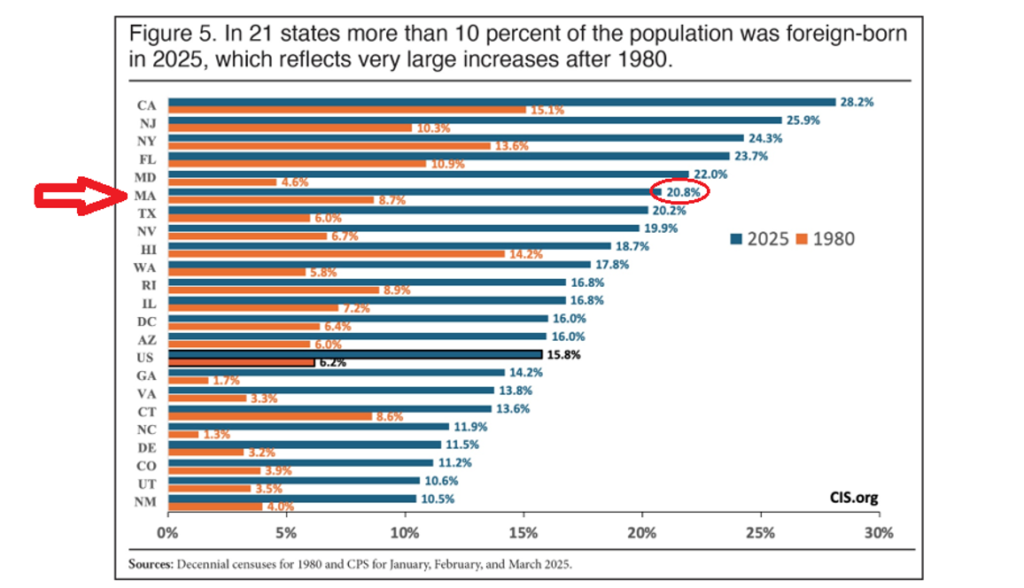
A study from the Center for Immigration Studies, “Foreign-born populations in 21 U.S. States, 2025,” says the percentage of Massachusetts foreign-born population has risen from 8.7% in 1980 to 20.8% in 2025.
Another paper, “Massachusetts: A Case Study in Mass Immigration and the Welfare State,” states Massachusetts spends a massive $1 billion annually in taxpayer money to subsidize emergency shelters to house thousands of newly arrived migrants.
CIS notes these government housing subsidies have raised prices and reduced opportunities for Americans: “Adding millions of people to the country through immigration drives up the cost of housing and reduces affordability relative to wages in areas of heavy settlement.….a 5-percentage point increase in the recent immigrant share of a metro area’s population is associated with a 12 percent increase in the average U.S.-born household’s rent relative to their income.” (from “Consequences of Illegal Immigration for Housing Affordability”)
Subsidy-fueled housing demands have inflated prices in Massachusetts. This – in turn – has caused an exodus of MA residents who move north to New Hampshire for housing.
Josiah Bartlett Center reports southern New Hampshire’s Rockingham and Hillsborough counties now serve as residential pockets for the Greater Boston economy. The report notes that “from 2010-2023 New Hampshire gained a net total of 98,879 immigrants from Massachusetts, nearly enough to create another city the size of Manchester” – our largest municipality.
Today, New Hampshire ranks 2nd in the nation for out-of-state commuter density. 15% of employed Granite Staters commute out-of-state to work. The “NH-to-MA pipeline” accounts for 80% (over 82,000) of that daily NH commute:
Commuter Data
| Rank | U.S. State | % of Workforce commuting Out-of-State |
| #1 | Maryland | 18% |
| #2 | New Hampshire | 15% |
| #3 | Rhode Island | 13% |
| #4 | New Jersey | 12.8% |
| #5 | Delaware | 11.5% |
(US Census; Gemini)
Rising home prices and limited inventory have been the predictable outcome for New Hampshire. Our affordability crisis is not the product of overzealous local planning boards – it’s primarily due to Massachusetts’ decision to distort market demand with massive subsidies to house legal and illegal immigrants.
While the NH Business Review notes industry lobbyists continue to clamor for “solutions that create more housing supply,” Granite Staters in my district and other towns say they resent being told they must “expand housing” and sacrifice the rural character of their neighborhoods.
New state mandates forcing municipalities to “increase density” and absorb a subsidy-fueled distortion are in fact unnecessary. Housing costs nationally have begun to decline, as the Trump administration pursues deportations and self-deportations of migrants present unlawfully.
The New York Post reports that
“President Trump’s H-1B clampdown mixed with mass tech layoffs is cooling the Texas suburbs, and other parts of the country — and that may be the point. Indian tech workers once turbocharged home prices north of Dallas. Now they’re gone — and a housing correction is already underway.
For years, the suburbs north of Dallas were ground zero for one of the most extraordinary housing booms in America. Subdivisions multiplied. Prices soared. Builders couldn’t put up homes fast enough. The engine behind it all was a wave of Indian-born H-1B visa workers flooding into high-tech jobs along a corporate corridor that attracted more company headquarters relocations than anywhere else in the country between 2018 and today, according to real estate firm CBRE Group.
Now that engine is sputtering — and the White House may be fine with that. Trump’s escalating crackdown on the H-1B program, which grants temporary visas to high-skilled foreign workers, has helped trigger a price correction in one of the nation’s most overheated regional housing markets… In Collin County — the suburban epicenter of the boom — home prices fell nearly 9% year-over-year as of February, more than double the 4% drop recorded across the broader Dallas-Fort Worth metro, according to Redfin data. The retreat of Indian buyers from the market, once the dominant force behind new home sales in the area, is beginning to function like a release valve.”
CNBC recently noted that, “After several years of a lean and pricey housing market, real estate agents are starting to see more balance.”
And rental data released for June 2026 indicates, “Rent prices nationally are down 1.5% compared to one year ago…The national median rent has now fallen from its 2022 peak by a total of 4.4%… Austin has seen the nation’s sharpest decline among large metros – the metro-wide median rent there has fallen 5.1 percent in the last 12 months and is down more than 20% from its 2022 peak.”
Treasury Secretary Scott Bessent recently stated: “People don’t want to admit it: where ICE goes, RENTS GO DOWN.”
New Hampshire doesn’t have a housing supply crisis; we have a migrant crisis. New home construction will continue across New Hampshire through careful municipal planning and thoughtful local discussion. Meanwhile, the immediate reduction in migrant access to subsidized housing will be the key to rapidly improving affordability for all Americans.
