
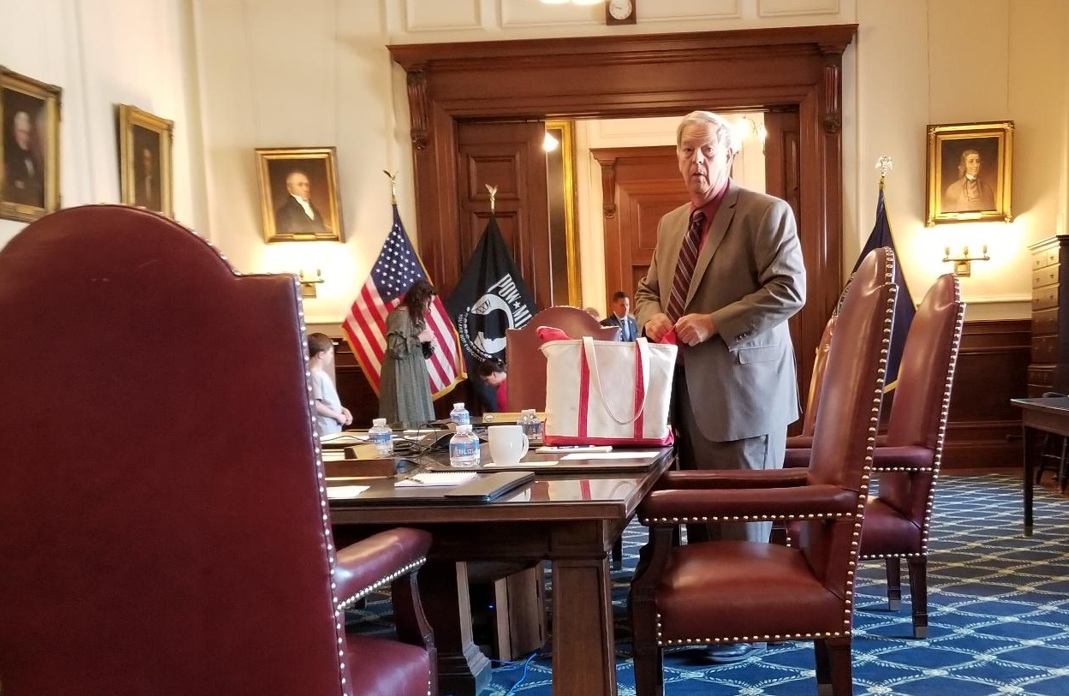
Though one body is elected and the other is appointed, and they’re in 2 different branches of government, the executive council and the supreme court have a few things in common. One of them is that they both have five members and must vote on things, whether it’s to confirm an appointee, approve an expense, or rule in someone’s favor.
Most people already know the highest court is in plenty of disarray right now with an embattled member, an upcoming retirement of another member, and many conflicts of interest, but let’s talk about the executive council, whether or not Karen Liot Hill (KLH) keeps her seat for the rest of the term. I can’t be alone in wanting to know what happens when a seat becomes vacant, no matter the reason (resignation, impeachment, death). This is government, after all, and the thought of moving millions of dollars along money trails throughout the state coming to a screeching halt isn’t something one would hope or expect to happen, so some research is in order.
I had many questions to ask in preparing for this article, so I emailed Councilor Wheeler those questions. Hours later, his reply arrived and I was able to get my answers from him or an internet search after his clues pointed me to where to look. Since I’m not alone in being relatively new to paying attention to state house activities, I thought people who have tuned in more recently would like to know a few things.
The most recent vacancy was created in November 2013 by the death of Ray Burton, a predecessor of Councilor Kenney. This was 11 months after Burton was reelected in 2012. Kenney won a special election in March 2013. A few other details were that Maggie Hassan was the governor, and it appeared to be the “Executive Council from Hell,” seeing that the 4 other seats after the 2012 election were occupied by Colin Van Ostern, Beverly Hollingworth, the PappASS, and Deb Pignatelli. That body was 80% blue garbage, so that’s what Burton and Kenney had to deal with in addition to the senior Maggot. Let’s talk about the governor’s role in addition to chairing the meetings.
Wheeler confirmed that the governor is never a tie breaker, which is something I asked about when only four members are voting, but she has the power to reject the body’s OTP vote. A more recent example of that power being used (for good, believe it or not) was in 2017 when Volinsky, Prescott, and the PappASS wanted to raise the tolls. The Damn Emperor put the kibosh on that one! Wheeler also confirmed that there is never a temporary “acting member,” something I asked about due to governors in other states appointing “acting senators” to serve until a special election. John Kerry, BO, and the vacancies they created come to mind in those two blue states.
When Councilor Kenney took his seat in the spring of 2013, he was a minority of one in a sea of blue garbage. I’m sure Aldermen Tyler Gouveia, Chris Thibodeau, and John Sullivan can relate to that, given they have 12 swampster peers and the worst mayor on earth in Nashua. Kenney was on the unfortunate side of an imbalance of power, just like KLH is today. “Irrelevance” might be your thought, but it’s not uncommon for that body to vote 3-2 or 2-3 on things, so KLH’s seat, as blue as it is, might not always be as irrelevant as one might hope. Has anyone talked to Janet Stevens about Caswell? All the media outlets have ignored her, but she has voted the right way on essential things in the past. I recall several instances where she and Wheeler voted against the bad actor, only to be steamrolled by the other three.
Given that a vacancy created in November of an odd-numbered year took 4 months to fill, it is reasonable to assume that, in the best-case scenario, KLH’s impeachment sooner rather than later would result in the same amount of time with only four members in the body voting. That leads back to my previous question to ponder: are all the efforts and resources needed to get rid of KLH a worthy investment? The answer depends on the timeline and how fast it moves.