

While righteous indignation is spreading over the so-called Somali affair—real or imagined—the question Americans should be asking is not who offended whom, who received money, or which group violated some moral expectation, but what structural architecture of the Administrative State makes situations like this inevitable in the first place and why Americans are conditioned to argue about recipients instead of the system that produces the money flows themselves.
Social media is flooded with outrage over Somali daycare centers extracting public funds, yet the same people expressing moral disgust are almost completely silent about the routine, normalized transfer of more than $205 million in federal economic development dollars across Maine to towns, businesses, hospitals, colleges, chambers of commerce, and regional planning bodies announced by Senators Collins and King just last year. This selective outrage is not accidental; it is the psychological byproduct of a system designed to obscure structure and redirect attention toward outcomes.
In Maine, Republicans proudly announced the completion of a $17.8 million, two-mile stretch of Route 1 in Searsport, with $9.2 million coming from congressionally directed spending. That money did not come from Maine. It was extracted from taxpayers across the country and redistributed locally to generate political credit and institutional dependency. The remaining $8.6 million was paid by Maine taxpayers, who were compelled to match and absorb project costs in order to access the federal funds in the first place. This is not investment, and it is not free enterprise. It is a wealth transfer mechanism that operates through political allocation rather than consent, competition, or constitutional authority. To date, no politician involved in this project has made the full budget, conditions, or long-term obligations of that “magical road” available for public scrutiny, which is itself an indictment of how this system functions: money first, transparency never.
At the same time, the office of Susan Collins published a detailed list of federal grants distributed throughout Maine under programs like the Catalyst Program and Timber for Transit. The recipients include towns, utility districts, hospitals, community colleges, development corporations, chambers of commerce, regional councils of government, trade associations, and NGOs. These are not emergency expenditures or disaster relief. They are routine capitalization payments that replace local decision-making with federal dependency. The public can review this ledger directly through Senator Collins’ newsroom release and what becomes immediately clear is that the federal government is functioning as a national development bank with no constitutional mandate to do so. Roads, water districts, town squares, snowmobile trails, hospitals, and regional planning agencies are not enumerated federal responsibilities, yet they now exist in a permanent state of federal financial supervision.
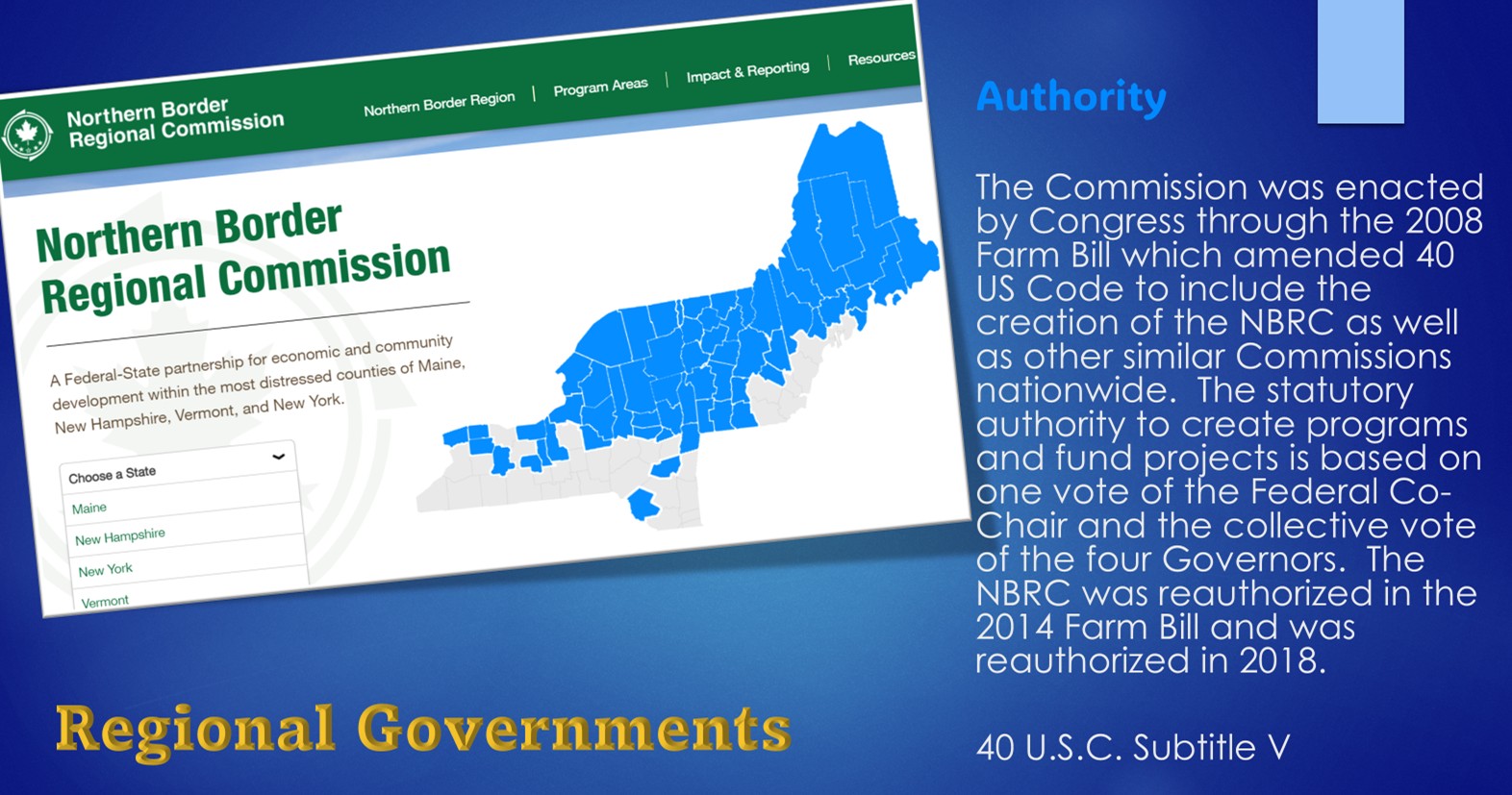
This same model is institutionalized through entities like the Northern Border Regional Commission, a Federal-State partnership for economic and community development in northern Maine, New Hampshire, New York, and Vermont. Each year, the NBRC provides federal funds for critical economic and community development projects throughout the Northeast. According to its own mission statements, these investments “lead to new jobs being created and leverage substantial private sector investments.” That is exactly the problem. The government claiming the authority to create economic prosperity is at the very minimum unconstitutional according to the original design of the Constitution, but it also borders on a system that is neither classical capitalism nor strict socialism, but something closer to corporate capitalism or corporatism—where private and public power fuse in managed economic allocation.
What is striking about the NBRC, like all federal economic development authorities, is that it does not act through representation nor consent but through dependency. Counties, towns, and regional districts are slowly hollowed out, not by legislation abolishing them, but through the creation of parallel administrative structures that control funding, planning, and compliance. Local governments are not abolished; they are financially subordinated.
Whether the money is being extracted by Somali-run NGOs, by Republican legislators funneling earmarks into favored projects, or by regional planning authorities administering federal grants, the underlying violation is the same. Both are drawing from an unconstitutional system that rewards dependency, not representation. Both are participating in a structure James Madison explicitly warned against when he said that if Congress could spend money for whatever it judged to promote the general welfare, then the federal government would no longer be a limited one but an unlimited one in practice. Thomas Jefferson echoed this warning when he argued that taking from one group to give to another under color of law violates the first principle of association and destroys republican government. These were not abstract philosophical concerns. They were concrete warnings about the exact system we now inhabit.
The reason one group receives national vilification while the other is praised for “bringing money home” is not legality, morality, or constitutional fidelity. It is narrative management. Americans have been trained to moralize about who gets the money rather than question why the money exists, who authorized it, and what it does to the structure of government. This is how the Santa Claus psychology is cultivated: the federal government no longer represents the people; it performs for them. It positions itself as the benevolent provider while quietly dissolving the conditions necessary for self-government. Towns no longer govern; they apply. Businesses no longer compete; they qualify. Citizens no longer consent through representation; they pay through taxation and compliance.
This system was explicitly rejected in early American history. The Founders opposed federal assumption of state debts, internal improvements funded by the central government, and national development schemes precisely because they understood that control follows funding. Even Alexander Hamilton’s limited financial programs were controversial for this reason, and later proposals for federally funded infrastructure were vetoed by presidents like James Madison and James Monroe as unconstitutional, despite their popularity. What Americans are witnessing today is not a deviation from that warning, but its fulfillment.
We do not have representative government anymore in any meaningful sense. We have a managerial state that distributes resources, conditions behavior, and manages expectations while insulating itself from accountability. The public argues endlessly about corruption, morality, and identity while ignoring the machinery that makes corruption routine and morality irrelevant. Until Americans learn to argue about structure instead of spoils, the Administrative State will continue to operate exactly as designed, producing dependency, resentment, and confusion while convincing everyone that the real problem is someone else’s share of the pie.
James Madison – Federalist No. 41
“If Congress can do whatever in their discretion can be done by money, and will promote the general welfare, the Government is no longer a limited one.”
Thomas Jefferson – Letter to James Madison (1796)
“To take from one, because it is thought his own industry and that of his fathers has acquired too much, in order to spare to others… is to violate arbitrarily the first principle of association.”
James Madison – Veto of the Bonus Bill (1817)
Madison vetoed a federal internal improvements fund as unconstitutional, affirming the federal government lacked authority to unilaterally fund local infrastructure.
James Monroe – Veto of Internal Improvements Bill (1822)
Monroe upheld constitutional limits by vetoing a federally funded internal improvements bill without express constitutional authority.
Authors’ and Speakers’ opinions are their own and may not represent those of Grok Media, LLC, GraniteGrok.com, its sponsors, readers, authors, or advertisers.
Disagree, agree, Got Something to Say, We Want to Hear It. Comment or submit Op-Eds to steve@granitegrok.com
