

As a lifelong athlete and coach of girls, I refuse to pretend that biology is bigotry—or that “inclusivity” is more important than fairness, grit, and the female category itself.
- It’s not about inclusivity
- The science is not ambiguous
- I know what it is to hate one’s body
- Look at the WNBA
- The medical side is equally disturbing
- Conclusion
The transgender issue is once again at the forefront of the culture wars. Just when some hoped it might fade, it has thrust itself back into news, sports, and politics. It never actually went anywhere.
I write this as a woman, a lifelong athlete, and a coach of girls’ and women’s gymnastics. From the earliest age, I learned the unforgiving truth of sport: you are only as good as the next athlete. Someone will always be stronger, faster, quicker, jump higher, or more flexible. Failure is constant. That reality alone is daunting for any female athlete. When institutions allow males into the female category, the contest ceases to be the same. It becomes an entirely different ballgame.
Sports were never about “inclusivity.” That claim is fiction. Sports is competition. It is learning how to fail and get back up. It is looking at yourself honestly and knowing what you must do to become better—stronger, faster, more flexible. It is leadership. It is training hard every single day. It is working through pain and discomfort. It is pure grit. What has happened to grit? Society has grown lazy in both mind and body. Too many give up the moment they cannot get what they want immediately. They say “I can’t,” and that produces lazy, undisciplined, unmotivated people. Claiming sports exist for inclusivity takes away everything they are meant to be.
At its core, sport provides fair physical competition—a setting where people test skill, strength, speed, endurance, discipline, and teamwork under shared rules. It improves fitness and mental well-being. It builds character through effort, resilience, accountability, and sportsmanship. It rewards excellence by determining who performs best in a defined category. Competitive sport has a particular purpose: preserving meaningful, rule-bound competition so results reflect athletic performance rather than unfair advantage. Recreational activity can be broad. Sex-based competitive categories exist so females have a fair opportunity to compete and win.
The science is not ambiguous. As the Independent Council on Women’s Sports amicus brief filed in the Supreme Court—signed by more than 135 female athletes, coaches, officials, and parents, including Olympic champions and NCAA All-Americans—makes clear, biological sex is the dominant factor in athletic performance. Post-puberty the male-female performance gap routinely reaches 10–50 percent depending on the sport. Males have substantially greater muscle mass and strength even after adjusting for height and weight, longer and denser bones, and greater leverage for explosive power. These differences appear well before puberty. Large studies of children show 9-year-old boys already outperforming girls by nearly 10 percent in sprints, 16 percent in the mile, 9.5 percent in standing jump, and 33 percent more push-ups. Higher androgen levels in male infants during the first months of life imprint structural advantages that persist.
Testosterone suppression and cross-sex hormones do not erase the male advantage. Peer-reviewed reviews of multiple studies find that even after 12 to 36 months of suppression, muscle mass, strength, and lean body mass remain substantially higher than in female reference groups. A mediocre male who could not qualify for NCAA championships as a man can become an All-American and national champion once allowed into the women’s category, displacing elite female athletes who trained their entire lives. The same brief documents the trauma of forced shared locker rooms: women describing the shock of a fully intact male undressing in their presence, the instinctive covering, the sense of violation, and the clear message that their privacy and category no longer matter.
I know what it is to hate one’s body. I battled anorexia and bulimia for more than twenty years. I understand body dysphoria and the desire to look or feel different. I received help from behavioral therapists who treated the underlying distress rather than affirming a falsehood. Gender dysphoria was once understood as a form of body dysmorphia or dissociation. We abandoned that clinical approach for an ideology that insists sex is malleable and that any boundary is bigotry. That ideology is now invading girls’ high-school sports, women’s collegiate programs, professional leagues, prisons, and bathrooms.
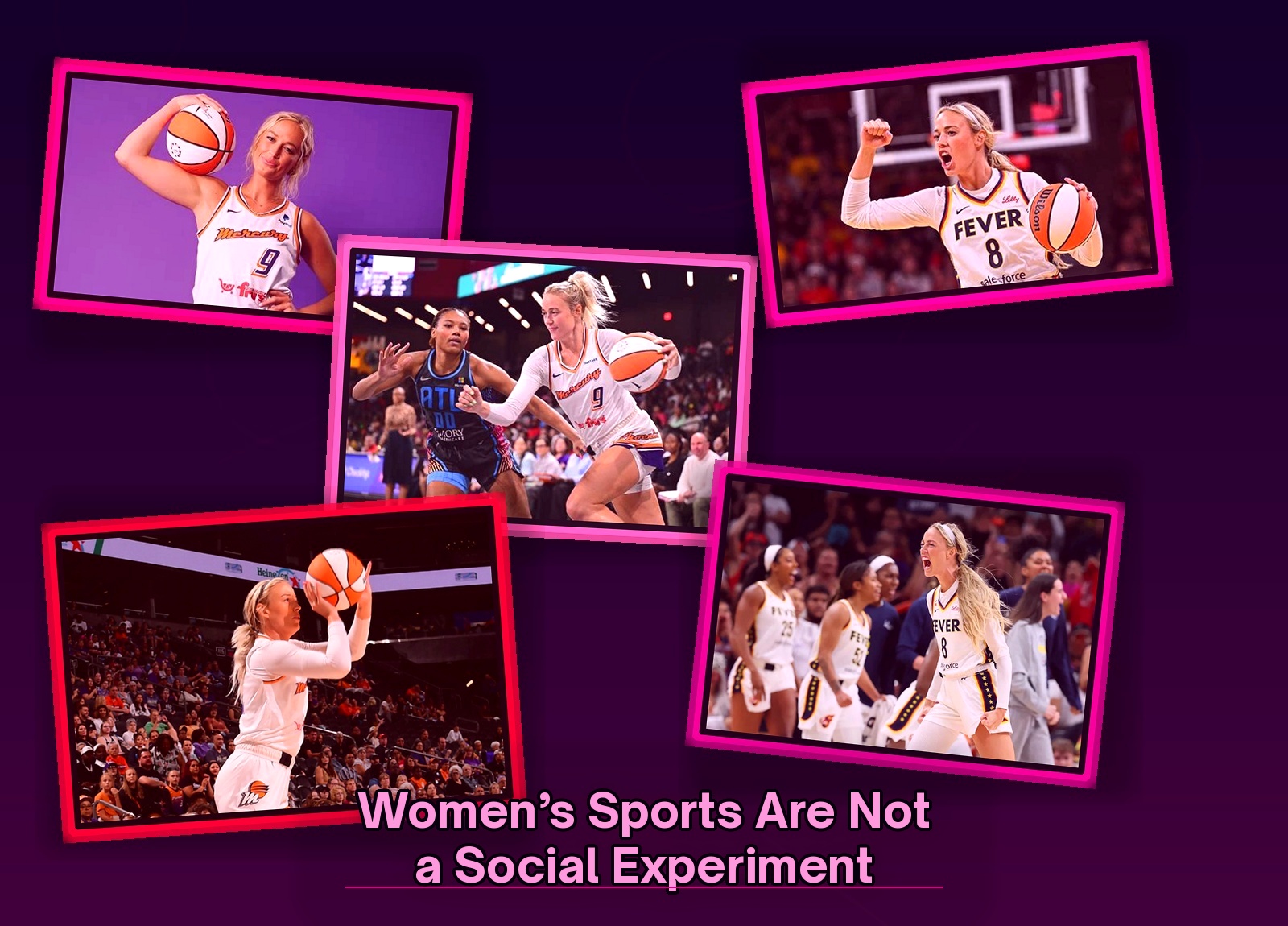
Look at the WNBA. Sophie Cunningham, an Indiana Fever guard, stated a simple, majority view in an ESPN profile: she wants to protect young girls in locker rooms and sports who should not have to compete against biological males. The response was predictable. Coaches in the league publicly signaled support for males in women’s sports. Protests and counter-protests appeared at games. A staffer reportedly tried to suppress a Riley Gaines sign supporting Cunningham.
Meanwhile, a biological male, Julie Tétart, is dominating a French women’s basketball league with averages that would make any honest observer pause. The controversy has become a proxy war that sucks the oxygen out of the actual game. One side refuses to admit biological reality and treats any guardrail as existential bigotry. Parts of the other side respond with hyperbole and cartoonish contempt for the league itself. Both escalate. The product suffers. Institutions that should protect the female category prefer ideology to integrity; they would rather damage the very sports that once advanced women than admit sex is real and matters.
The same pattern appears in collegiate athletics. Legislation marketed as solving NIL and conference chaos has been drafted with overly broad exemptions that would shield the NCAA from Title IX accountability on eligibility decisions—effectively a Trojan horse for continued male participation in women’s categories. More than 80 percent of the public rejects males in women’s sports. Female athletes deserve the full protection of Title IX. Solve the other problems if you must, but do not gut the female category to do it.
The medical side is equally disturbing. The WPATH Files revealed private discussions of regret, experimental surgeries on minors, and complications so severe that even some surgeons admit patients may not maintain a neo-vagina. Reporting has documented WPATH-linked advocacy that female inmates should “overcome transphobia” and share prisons with males. An FTC lawsuit has been filed against the organization. A heavily criticized “zombie study” continues to be cited despite fundamental flaws. What was once treated as a mental-health condition requiring careful therapy has been reframed as an identity that must be affirmed at all costs—even when the costs fall on women and girls.
Here in New England, the same ideology shows up close to home. Drag performances aimed at children from 0-18 have been held at the Keene Public Library. Males who identify as women are housed in women’s prisons. Sex offenders have used the women’s bathroom at the State House in Concord and at Planet Fitness. Governor Kelly Ayotte did not advance protective legislation for women and girls in single-sex spaces this session. These are not abstract national debates. They are local realities that erode the safety and fairness once taken for granted.
Claims that protecting the female category is “hate” or that transgender people are being denied rights are propaganda. No one is stopping transgender individuals from existing, working, or competing. They can compete in open or co-ed categories, or form their own if numbers warrant. Nothing is taken from them. What is taken from women and girls is the one space society once guaranteed them—fair competition and private spaces free from male bodies.
Too many people today—especially certain educated elites—want to pat themselves on the back for “kindness” and “inclusivity” until the moment that ideology actually harms people. They refuse to look at reality. Reality always wins in the end, and it eventually comes back to bite those who ignore it.
I am a live-and-let-live person. BUT….
I will not be silent when ideology causes measurable harm to the athletes I coach and to every girl who still believes hard work in a protected category can open doors. Women’s sports must remain for women. Women’s prisons, bathrooms, and locker rooms must remain for women. That is not bigotry. It is the minimum requirement for fairness, safety, and the continued existence of the category itself. The science, the lived experience of female athletes, and basic honesty all point the same way. Society needs to stop pretending otherwise.
