


Entering Charles Merriam’s Marble Cake Factory
The Administrative Procedure Act (APA), enacted in 1946, is often described as the foundational statute of modern administrative law. Its stated purpose was procedural: to regularize agency rulemaking, ensure public notice, provide opportunities for comment, and define standards for judicial review. As Encyclopaedia Britannica summarizes, the Act was intended “to ensure that agencies keep the public informed of their organization, procedures, and rules” and “to provide for public participation in the rule-making process.”
In that sense, the APA was presented as a restraint—not on the existence of administrative agencies, but on their discretion. It sought to discipline bureaucracy by procedure rather than dismantle it. Yet the statute also formalized and legitimized a new mode of governance: rulemaking by administrative agencies with the force of law.

The text of the Act makes this clear. The APA defines a “rule” broadly as “the whole or a part of an agency statement of general or particular applicability and future effect designed to implement, interpret, or prescribe law or policy.” Rulemaking is defined simply as the “agency process for formulating, amending, or repealing a rule.” Once issued in compliance with the Act’s procedures, such rules bind the public even though they are not statutes enacted by Congress.
Federal agencies themselves describe the APA not as a limitation on rulemaking, but as the framework that enables it. The Environmental Protection Agency, for example, explains that the APA “governs the process by which federal agencies develop and issue regulations,” including requirements for notice-and-comment rulemaking published in the Federal Register. The emphasis is procedural regularity, not substantive restraint.
This distinction matters because the APA does not merely regulate agency behavior; it authorizes a form of governance in which policy is made administratively rather than legislatively. Congress enacts broad statutory mandates. Agencies then fill in the details through regulations promulgated under the APA. Judicial review, where it occurs, typically focuses on procedural compliance rather than the wisdom of the policy itself.
The reach of this system does not stop at the federal boundary. Although the APA applies only to federal agencies, the rules generated under it are designed to operate nationwide. Their implementation almost always occurs through state agencies, not federal ones.
This is where the architecture becomes operational.
Federal programs are routinely administered through conditional spending arrangements. Congress authorizes funding. Federal agencies issue regulations under the APA defining eligibility, standards, reporting requirements, and enforcement mechanisms. States may decline participation, but doing so often means forfeiting funding streams that have already been integrated into state budgets and institutional planning.
Once a state accepts the funds, it agrees to administer the program “in compliance with federal law and regulations.” At that point, the state becomes the implementing arm of APA-generated rules.
Homeland security provides a clear illustration. The Department of Homeland Security issues regulations and binding guidance under statutory authority, following APA procedures. FEMA regulations, for instance, establish detailed requirements for emergency preparedness, mitigation planning, training standards, and post-disaster reporting. Those rules are written in Washington. But they are enforced by state emergency management agencies.
When a state seeks disaster assistance, its emergency management agency must demonstrate compliance with FEMA’s regulatory framework. State officials prepare plans, submit documentation, conduct trainings, and manage funds according to federal rules. Local governments experience the authority as state-level administration, even though the substance of the requirements originates in federal rulemaking.
The same structure appears in homeland security grant programs. DHS establishes regulatory criteria for intelligence sharing, information security, and operational coordination. States accept grant funding and create fusion centers or emergency coordination offices that enforce those criteria locally. The APA governs the creation of the rules; state agencies carry out the enforcement.
This arrangement is often described as cooperative federalism, but cooperation suggests symmetry. In reality, the leverage is asymmetric. Federal agencies control the rulemaking process. States control only whether to participate, and withdrawal becomes increasingly impractical over time.
State Administrative Procedure Acts complete the system. Every state has adopted its own APA, and most are modeled closely on the federal statute. They define “rules” in nearly identical terms and establish parallel procedures for notice, comment, and adjudication. When a state agency adopts federal standards—sometimes explicitly “by reference”—it uses its own APA to embed those standards into state law.
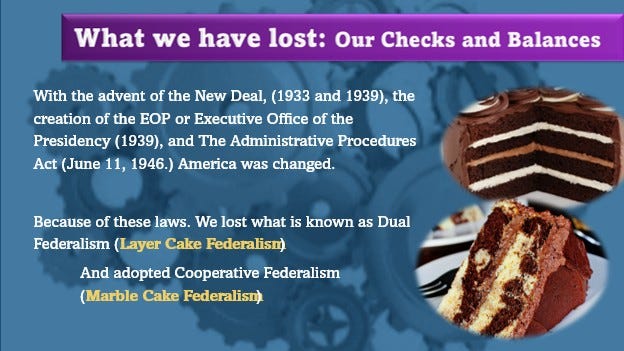
The result is procedural harmonization. Federal agencies generate rules under the APA. States enforce them using administrative structures designed on the same model. The distinction between federal and state authority becomes formal rather than substantive.
Over time, this produces institutional conditioning. State agencies develop professional cultures oriented toward federal compliance. Staff are trained to meet federal reporting requirements, manage federal grants, and avoid regulatory risk. Even when administering purely state-funded programs, those habits persist.
State programs often feel federal even when they are not. The administrative logic has already been imported.
The APA was not enacted to abolish bureaucracy. It was enacted to regularize it. But in doing so, it provided the legal infrastructure for a system in which rulemaking authority could expand dramatically without corresponding expansion of direct federal administration. Federal agencies write the rules. States enforce them. Responsibility is diffused. Accountability is obscured.
Understanding this architecture is essential for evaluating modern policy debates. Questions about federalism, education reform, homeland security, or public health cannot be answered simply by asking whether a program is “federal” or “state.” The more important question is whether the program is administered by institutions already operating within an APA-generated regulatory ecosystem.
That question becomes unavoidable when examining education policy and Education Freedom Accounts—where state programs exist alongside agencies shaped by decades of federal administrative governance.
Bibliography
Administrative Procedure Act, 5 U.S.C. §§ 551–559.
Encyclopaedia Britannica, “Administrative Procedure Act.”
U.S. Environmental Protection Agency, “Summary of the Administrative Procedure Act.”
U.S. Environmental Protection Agency, “Administrative Petitions for Rulemaking.”
