

Like clockwork, it is once again time to talk about Daylight Saving Time. And why the heck not? You just moved the clocks back an hour to Eastern Standard Time—the time it’s supposed to be. And maybe you managed to milk that extra hour for something or not. I wake up an hour earlier and do stuff, so the notion that we get an hour of sleep back is lost on me.
Some folks manage to grab the extra zees. And last December, President-elect Donald Trump said that he and the new Congress would make an effort to end the practice of Daylight Saving Time.
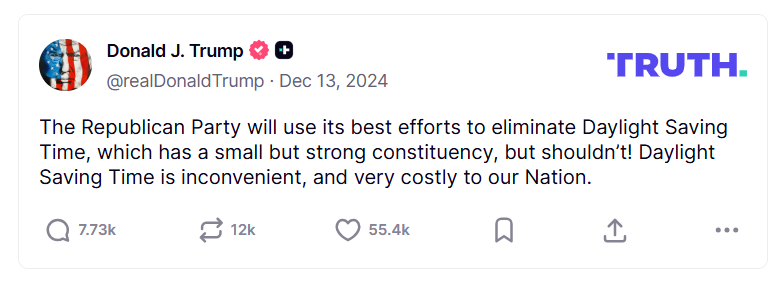
The clock is ticking. You’ve got until March.
Of course, Trump also said he wanted to annex Canada, and Greenland, and turn Gaza into a Mediterranean Vegas, and about a million other things he thinks that he says to spin people up. And spun up is an understatement.
I guess my first question is, will Democrats have to oppose it, and what does that look like? We’ve been messing up people’s sleep and biological rhythms for a while, not to mention confusing our pets about when they get to eat, but there’s no historical precedent.
Is there a rhetorical case for Daylight Saving Time? Was Hitler an opponent such that the progs could glom it onto the buffet of horribles that they claim justify their endless fascist mantras?
If he didn’t have enough Republican votes, he could probably go on Truth Social and monologue about how fabulous Eastern Standard Time is. The greatest, most beautiful thing ever to happen to time, it really is. The left would be clamoring to end it while demanding the immediate release of all the files.
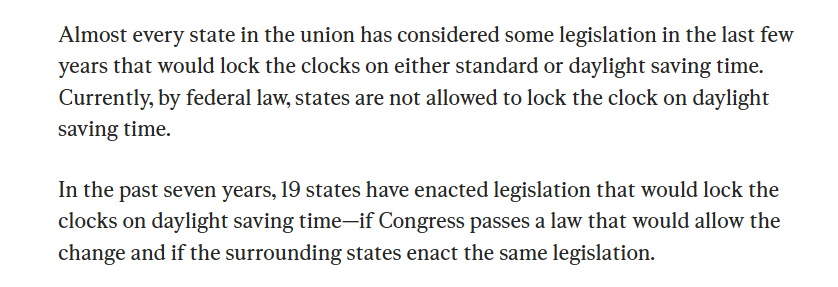
The Epoch Times was kind enough to give us a map.
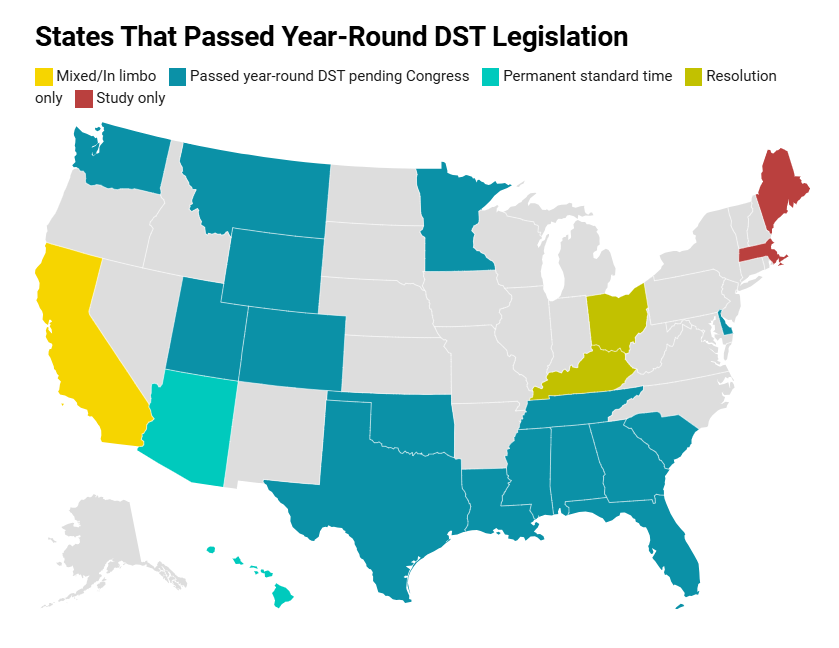
Most states are waiting on Congress to lock us into Daylight Saving Time, with two, Hawaii and Arizona, locking the clock on Eastern Standard. Everyone else is like, whatever.
When asked which they prefer, 56 percent of Americans would prefer daylight saving time year-round, with less light in the morning and more in the evening. Around 42 percent would rather have year-round standard time, with more light in the morning and less in the evening.
Of those who identified themselves as a “night person,” 61 percent preferred permanent daylight saving time, and 50 percent of those who identified themselves as a “morning person” preferred permanent standard time.
This is why we will very likely be stuck with the clock-changing routine for the near and distant future. It’s a rubber-necking issue. The closer you get to the “accident,” the more things slow down, and people contemplate the situation. Once it’s past, they speed back up without thinking about how or why that wasn’t them or if it could be.
And away we go.