

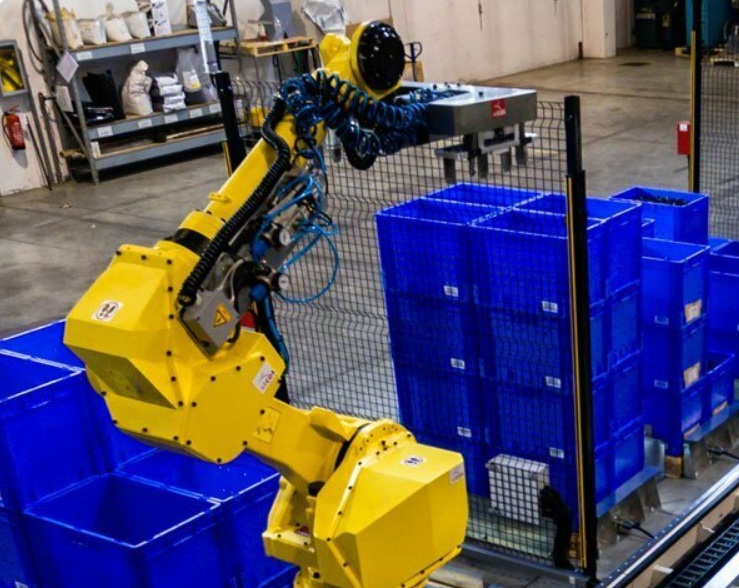
Walk into a modern manufacturing plant today, and you may not recognize it. Robotic arms move with quiet precision along assembly lines, automated systems handle tasks that once required teams of workers, and software monitors every stage of production in real time.
The transformation of the factory floor is not a distant prospect: it is already well underway, and its implications for workers, businesses, and communities deserve a clear-eyed look.
In this article, we’ll explore this topic, thanks also to the support provided by Arcos srl, a company that offers automated industrial finishing solutions.
A revolution decades in the making
Industrial automation is not new. Mechanization has been reshaping work since the Industrial Revolution, and each wave of technological change (from steam power to electricity to computerized machinery) has provoked similar anxieties about the future of human labor. What distinguishes the current moment is the pace and breadth of change.
Advances in robotics, artificial intelligence, and machine vision have extended automation into tasks that, until recently, required human dexterity, judgment, or adaptability. Welding, painting, quality inspection, material handling, precision finishing — processes once considered too variable or complex for machines are now routinely performed by automated systems.
What the data shows
The relationship between automation and employment is more complicated than either its most enthusiastic advocates or its harshest critics tend to suggest.
On one hand, there is clear evidence that automation increases productivity, reduces per-unit costs, and improves workplace safety by removing workers from hazardous environments. Manufacturers that invest in advanced automation are generally better positioned to compete globally and to sustain domestic production over the long term.
On the other hand, the transition is not cost-free for workers. Research consistently shows that automation displaces certain categories of jobs — particularly those involving routine, repetitive physical tasks — faster than new roles emerge to replace them.
The workers most affected tend to be those with fewer formal qualifications and fewer options for retraining, concentrated in regions where manufacturing is the economic backbone of entire communities.
A balanced assessment must hold both realities at once: automation creates wealth and opportunity at the aggregate level, while distributing its costs unevenly across the workforce.
The skills gap at the center of it all
Perhaps the most important (and most underreported) dimension of the automation story is the skills gap. As factories become more technologically sophisticated, the demand for workers who can program, operate, and maintain advanced systems grows steadily.
These are not low-skill positions. They require technical knowledge in areas such as robotics, industrial software, sensor systems, and data analysis. Yet the pipeline for producing such workers remains inadequate in much of the United States.
Vocational and technical education has been underfunded and culturally undervalued for decades, leaving many manufacturers struggling to find qualified personnel even as unemployment persists in the same regions where factories are located. Closing this gap is arguably the single most consequential challenge facing American manufacturing in the near term.
Lessons from abroad
Countries that have navigated the automation transition most successfully share a common characteristic: they treated workforce development as a core component of industrial policy, not an afterthought.
Germany’s dual education system (which combines classroom instruction with structured apprenticeships in real manufacturing environments) is the most frequently cited model, but similar approaches exist in Switzerland, Austria, Japan, and South Korea.
In these countries, automation did not hollow out the manufacturing workforce. It upgraded it. Workers whose routine tasks were taken over by machines moved into supervisory, technical, and maintenance roles.
The transition required sustained investment in training and a close partnership between employers, educational institutions, and government. But the results, in terms of both industrial competitiveness and workforce quality of life, have been broadly positive.
The road ahead
The United States faces a genuine choice. It can approach automation reactively, allowing displacement to accumulate until it becomes a crisis, then responding with emergency measures, or it can invest proactively in the infrastructure, education, and institutional partnerships needed to manage the transition well.
Neither outcome is predetermined. The technology itself is neutral; what matters is how society chooses to deploy it and how it prepares those whose working lives it will most directly affect.
The factory of the future is not a threat to be feared or a promise to be taken on faith. It is a challenge to be met: with clear thinking, adequate preparation, and a genuine commitment to ensuring that economic progress translates into broadly shared prosperity.
