


I’ve been warning about the behavior problems in New Hampshire schools. Parents and teachers in schools like Manchester and Nashua have been sounding the alarm bells that behavior problems are escalating.
I continue to urge you to revisit the New Hampshire laws that require schools to use a standardized approach to behavior.
The Multi-Tiered System of Support for behavior (MTSS-B) is a tiered system that standardizes behavior in the classroom. In addition, you can read how the positive behavior supports came from the federal Every Student Succeeds Act. If the state or school accepts federal money, they must then comply with the federal laws. What does this mean? Go here:
This means that every single child in a school that takes this federal grant money under ESSA is a target for universal subjective behavioral screening, labeling with a behavior disorder — the criteria for which experts do not agree — and psychological modification using admittedly experimental means. Most of this process occurs before a formal special education evaluation that requires parental consent occurs.
What does this mean for your public schools? It means that they have become pseudo-mental health centers gathering mental health data on your children. Who is forced to do this? The teachers working in your public schools. What is this doing to your teachers? In Keene, they are quitting.
The Union Leader ran an article about the concern over the teachers in Keene quitting. Parents are now concerned over the number of teachers who are resigning.
Keene High School parents are sounding off about a spike in teacher resignations since the beginning of the school year.
Parents posted an anonymous email they received listing the eight resignations the high school had since fall. The school is now attempting to get grant money to hire for a position in an effort to work directly with problem students. This fits into the MTSS=B model.
They are blaming the behavior problems on last year’s in-person and online classes. No one is even looking at the MTSS-B standardized model. Instead, they are blaming the students’ for their emotional and developmental mindset. That’s code for mental health.
While a child’s mental health is always a concern, there are times when there has to be boundaries set and consequences for those who push through them. What we are seeing is this attempt to label all of these behavior issues as mental health issues. This in turn waters down consequences. Some of these kids will push and push, especially if there are no real consequences.
As reported in “PBIS”: Behind the Feds’ Wacky Scheme to Modify Children’s Behavior, they provide an example of how one school at Deer Park Elementary school in Pasco County, Florida dealt poorly with the children’s behavior.
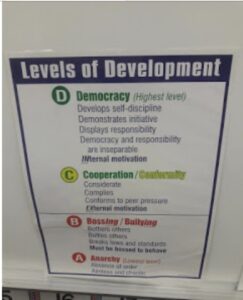
According to the Tampa Bay Times, the school had decided to implement PBIS school-wide due to concerns about an increase in behavior problems. Without consulting parents, they placed posters all around the school that had this nonsensical, illogical, subjective, and backwards rubric about behavior:
In this wacky scheme, “D” — which is usually a near-failing grade — is the highest level, standing for Democracy. “C” — typically an average grade — is the next highest level and requires students to “conform to peer pressure.” “B” and “A” — which are considered high grades by most people — in this scenario are the bad or “red” levels and stand for “Bossing/Bullying” and “Anarchy,” respectively.
When schools are turned into mental health facilities, we can see that there are negative consequences. First, the academics will suffer, but more concerning is, how bad behavior follows. If boundaries can be ignored by students, and there are no real consequences, it sends a message to the other kids that they don’t have to follow the rules either. This is exactly what parents in Manchester are reporting. Not only are the boundaries being broken, but they are also rewarding the students who exhibit bad behavior and ignoring the students who are following the rules.
Where will this eventually lead our schools? I don’t know. I am concerned though, that we may see an incident that is more serious than what has been reported by teachers and parents. I hope I am wrong. I hope that someone will consider what is going on and work to reverse this trend.
That would mean rejecting federal dollars aimed at turning the schools into mental health facilities.
Use that money to support mental health treatment centers outside the school system so the children who truly need intervention have access to good quality mental healthcare. Divert that money to the facilities and social services that are equipped to handle the children who need it. That means that they may have to be diverted away from the classroom until they are deemed safe to return.
It would mean reversing the current law that currently exists in New Hampshire that directs schools to become mental health facilities. Instead, direct students who need extra help towards social services and direct funding so that there is support for those who need it.
The behavior problems are escalating. Teachers are reporting this trend and so are teachers in New Hampshire. You can either ignore it or go to the root cause and fix it.
