

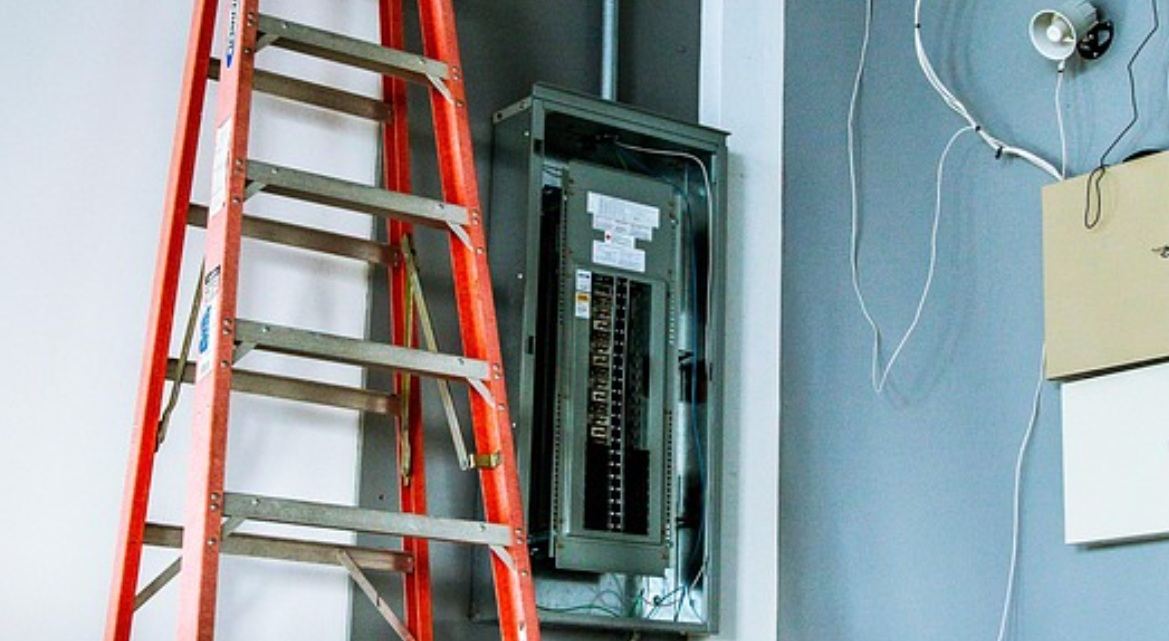
A breaker that trips twice in a week isn’t defective. Swapping it for a bigger one is the fastest way to turn a nuisance into a fire. The breaker is a sensor with a switch attached, and when it opens, it has already measured something on the circuit behind it and decided the condition is outside the band it was built to allow.
The useful question isn’t how to make it stop. The useful question is what, specifically, it keeps catching. What follows walks the circuit from the moment of the trip backward through the panel, through the wiring, and into the decision about what to fix.
Stage One: The Moment the Breaker Opens
A breaker opens for one of three reasons, and the first few seconds after the trip tell you which one. An overload is usually the slower, more common trip: too much current for too long, generally from stacking loads on a circuit that was rarely sized for them. A short circuit is the fastest, hot touching neutral with almost no resistance in between, and it slams the breaker open hard. A ground fault is current escaping to anything that isn’t the neutral wire, which includes a person.
The behavior of the trip usually tells you which one you have. A breaker that holds for twenty minutes and then opens when the microwave starts is an overload story. A breaker that won’t reset for more than a second before snapping back is telling you the fault is still on the wire. A GFCI or AFCI that trips the instant a specific appliance plugs in is pointing at that appliance, or at the outlet it touched.
Unplug everything on the circuit, reset the breaker, and add loads back one at a time. If the breaker holds with nothing plugged in, the load mix is the problem. If it trips with nothing plugged in, the problem sits upstream of any appliance you own, and this is where a licensed electrician earns the fee tracing the circuit back.
Stage Two: Count the Load Before You Blame the Breaker
Breakers are rated to carry their full number for short bursts, not forever. A breaker on a continuous load should sit well below its printed rating, because the terminals and the enclosure generally aren’t qualified to sit at the full number indefinitely. That’s the most common reason a breaker that looks “too small” is sized correctly for what it was given.
Walk the circuit and add up what shares it. A kitchen counter outlet feeding a toaster, a coffee maker, and an air fryer at breakfast isn’t a wiring failure. A bedroom circuit that also runs a space heater in winter isn’t a wiring failure either. Those are load problems, and the honest fix is either moving a load to a different circuit or pulling a new one for the appliance that keeps winning the fight.
Stage Three: When the Wire Itself Is Talking
Load is the easy answer. The harder answer is the circuit itself. Insulation ages. Staples cut into cable over decades of thermal cycling, rodents chew sheathing, and old backstabbed outlets loosen until a connection arcs every time something draws current through it. None of it shows on the outside of the wall. All of it will trip a modern breaker that is doing its job.
A few patterns point past load and into the wire:
- Trips with no obvious load. The breaker opens when the circuit is almost idle, or at odd hours. That’s the signature of a fault on the wiring itself, not on anything you plugged in.
- Warm or discolored devices. An outlet or switch that feels warm, smells faintly like hot plastic, or shows browning around the screws is a loose connection generating heat. Breakers upstream may open intermittently as the connection arcs.
- AFCI trips that follow no appliance. An arc-fault breaker is listening for the signature of a series or parallel arc on the branch wiring. If it keeps opening and no single device is the trigger, it is likely catching the wire.
- GFCI trips at tiny leakage. A GFCI is designed to open at roughly 5 milliamps of imbalance, in a small fraction of a second. Repeated trips mean current is finding a path it shouldn’t have, often through damp insulation or a cracked device.
Treat any of these as nuisance trips, install a bigger breaker to keep the lights on, and you’ve removed the only part of the system that was warning you. The branch wiring behind the drywall is where most residential electrical fires actually start, which is the entire reason AFCI protection was added to the code in the first place.
