

This time of year marks the Article V Convention season when out-of-state lobbyists and their allies converge upon Concord with promises to either save our republic or democracy if only we could hold an Article V Convention.
This movement is well-funded and organized. It is made up of folks from both sides of the political spectrum. It includes Convention of States, founded by Mark Meckler, US Term Limits, Move to Amend, and Wolf PAC, founded by the odious Cenk Uygur. Convention of States has retained the services of Mike Farris, who supports a “restructuring” of the U.S. Constitution, which includes a 50-member Supreme Court. Article V Convention supporters on the Left, among other things, want to abolish the Electoral College, and those on the Right want to pass balanced budget and term-limit amendments.
Our Founding Fathers made it very difficult to amend the U.S. Constitution. Since its ratification, there have been close to 12,0000 proposed amendments to the Constitution, but only 27 passed. Of those 27, ten were added at the same time in 1791. The 21st Amendment rescinded the 18th, which means we have only 25 operative amendments.
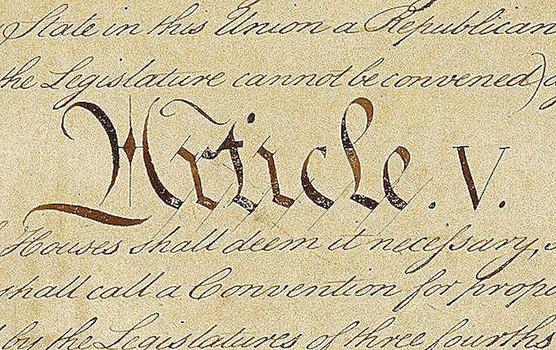
Article V of the U.S. Constitution:
“Congress, whenever two thirds of both houses shall deem it necessary, shall propose amendments to this Constitution, or, on the application of the legislatures of two thirds of the several states, shall call a convention for proposing amendments, which, in either case, shall be valid to all intents and purposes, as part of this Constitution, when ratified by the legislatures of three fourths of the several states, or by conventions in three fourths thereof, as the one or the other mode of ratification may be proposed by the Congress; provided that no amendment which may be made prior to the year one thousand eight hundred and eight shall in any manner affect the first and fourth clauses in the ninth section of the first article; and that no state, without its consent, shall be deprived of its equal suffrage in the Senate.”
Since the ratification of the Constitution, only the first method has been used. We have never held an Article V Convention, and for good reason.
Article V does not give states the power to limit a convention to one issue or a topic. Although Congress has attempted to pass legislation guiding a convention, there are currently no laws or legal guidelines for one, and even if there were, there is no guarantee that they can be enforced.
Would this convention be one state, one vote, or would it be based on Congressional representation, giving California 54 votes and New Hampshire four votes? Will delegates be appointed or elected? Would members of state legislatures and of Congress serve as delegates? How many delegates would share the values of the Founders? We don’t know the answers to these questions, and neither do proponents of a convention.
Proponents tell us that delegates to a convention would be obligated to obey the instructions of state legislators, but these instructions are unenforceable since delegates serve in a federal capacity. They also tell us that with 3/4ths of the states needed to ratify proposed amendments, it would be impossible to ratify “bad” amendments. Well, “bad” amendments have been ratified without a convention-the 16th and 17th come to mind. Congress could also establish state ratifying conventions, leaving state legislators out of the approval process entirely.
Refuting Amendments that Article V Proponents want to pass:
Term Limit Amendment:
1. While it may “throw the bums out,” it will also throw good legislators out.
2. It will not do anything to change the ideological make-up of the voters. Liberal or conservative members of Congress will be” termed out” only to be replaced by those of like-mind.
3. It will create a permanent lame-duck Congress.
4. It could lead to more voter apathy. Don’t like your member of Congress? Not to worry. He or she will be gone in a few years. We already have a problem with voter apathy. In the 2024 general election, only 63.9% of U.S. registered voters turned out to vote. In 2022, only 46.2% turned out. We did a bit better in New Hampshire, with 63.9% turnout in 2024 and 56.3% in 2022. Term limit amendment supporters tell us that a significant percentage of people – up to 3/4ths-have an unfavorable view of Congress. If that is so, it should show up at the ballot box, but it doesn’t in the Granite State.
5. It will take years before it goes into effect. Supporters of a term limit amendment warn us of dire consequences if the amendment isn’t passed. All of the proposed term limit amendments I have seen call for two six-year terms for the Senate and six two-year terms for members of the House. Even if we cut that in half, between ratification and implementation, it will still take eight or more years to take effect.
6. We already have term limits: frequent elections.
Balanced Budget Amendment:
Another amendment that sounds reasonable, but every proposed balanced budget amendment has two escape clauses: War and a State of National Emergency. While this amendment may not lead to a formal declaration of war , it would certainly prove an incentive to keep our nation in a state of emergency. We are currently under forty such emergencies. It would also make states of emergency constitutional.
What we need is a constitutional budget , but the majority of folks in both major parties don’t want one.
Repeal the Electoral College Amendment
This would give states with large populations like California, New York, and Illinois permanent control of the Presidency.
New Hampshire currently had one extant application for an Article V Convention. Over the past few years, the New Hampshire House has defeated new resolutions for a convention.
A convention requires resolutions from thirty-four states. Convention of States currently has 20 states in its column. Thankfully, since 2000, 16 states have rescinded their Article V applications. That gives us 33 states with extant applications, including New Hampshire’s.
New Hampshire needs to say no to an Article V Convention and rescind its application.
Readers who would like additional information on this issue are welcome to email me at campconstitution1@gmail.com
Hal Shurleff is the Director of Camp Constitution, the plaintiff in “Shurtleff v Boston”—a 9-0 U.S Supreme Court decision, and a resident of Alton.
Authors’ and Speakers’ opinions are their own and may not represent those of Grok Media, LLC, GraniteGrok.com, its sponsors, readers, authors, or advertisers.
Disagree, agree, Got Something to say? We Want to Hear It. Comment or submit Op-Eds to steve@granitegrok.com
