
Governor Margaret Wood Hassan signed New Hampshire’s hands-free device law in 2015. We told them it wouldn’t do what they claimed and might just make matters worse. After all, the research showed that people who got distracted still would, and people less inclined would be more often, as they tried to avoid detection.
The law prohibits drivers from using hand-held electronic devices while driving. This does not include styling wands, razors, or anything else you can hold. It also does not include interacting with embedded in-vehicle devices the size of iPads or anything else distracting, including passengers.
We already had a distracted driving law that would come into play if that sort of thing could be implicated. We didn’t ban the behavior, but we punished it after the fact if it could be demonstrated to be relevant, which is difficult even now (a confession always helps).
Pre-hands-free law research was quite clear about how talking to someone in the car was statistically as distracting as holding a phone to your head – and no, there weren’t really any lobbyists for these truths and many others.
Oh, and hands-free laws are busybody freedom-disrupting antics that punish everyone for the chronic misbehavior of a few. The same few who will keep misbehaving, a fact that also did not appear to have any lobbyists during testimony, not that it would have helped.
There were always going to be enough busybodies in both parties to push this to a Democrat governor’s desk, and there was no way she wasn’t going to sign it.
Ten years later, there is no evidence it did anything but inconvenience safe drivers and jack up car prices, as every model had to have hands-free tech, even the sort that was more distracting than talking with a cell phone held to your ear.
That’s a revelation to some, inspires disbelief in others, but here’s something even more startling. When I asked the New Hampshire Department of Safety for crash and fatality data for the past ten years, guess what they told me. We can only give you five. The records are purged after that.
Being the skeptic that I am, my first thought was, what are you trying to hide? My second was, good thing I already had it for 2014-2020. This isn’t the first time I’ve asked, and it used to be a lot easier. One contact, no RTK, just ask as a member of the media and they spit it out in a few days.
To their credit, the five years of data I did get is detailed. Broken down by town, crash type, for each year, with totals. Both 2021 and 2026 are half years. 7/30/21 to 7/30 26. That took ten days after they agreed to provide it, which took more than five days to decide. No car fire. I was in no hurry, so my thanks to them for the information, but I’m not buying the need to purge after five years’ schtick, because I’m skeptical of government and this would eventually make it impossible to expose flaws in the thinking.
I also got fatality data in the same way. By town. 21 to 26.
NHTSA keeps better historical data, but the Obama Admin boloxed up what used to be a very simple process, and I’ve not been back there since. But I will, and I have the data from past posts plus what I’ve just received.
Keep in mind I do not have total vehicle miles traveled by year, which is an important piece of information in this area of introspection. More miles change incidence rates in a meaningful way, so these are just totals with no other context, but we were told there would be fewer fatalities if you took this freedom from us, and that didn’t happen.
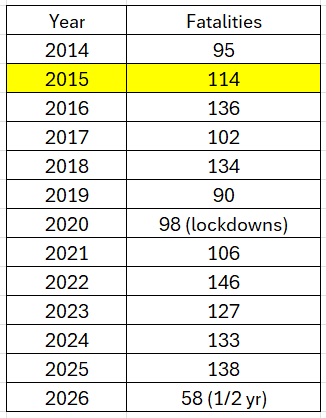
It is entirely possible that the added population, changes in tourism, increased VMT, and other factors could mean some improvement, but the claim was fewer deaths, and that never happened. You could argue they went up.
Impairment, speed, and distraction continue to be the primary causes of motor vehicle-related deaths. Mobile phones are a huge distraction, especially when used by those who think they can text and drive. That was, of course, the biggest concern, but if you drive, you know. People are still doing that. The law didn’t stop them, and we never really saw any decline in transportation-related deaths.
Not that it matters.
There is a perception that this is necessary and does good, the same one that convinced legislators to pass it in the first place despite it being painfully easy to do your own research and see how little difference it would make at the expense of everyone else.
Town by town crash data 7/30/21 to 7/30/26
Fatalities by town 7/30/21 to 7/30/26