

A New Hampshire case study in vetting failures, sex-based privacy, and why women and girls deserve real boundaries in law.
When Warning Signs Are Ignored: Laughton, SB 552, and the Failure to Protect Women
New Hampshire women and girls should never have been put in the position of having to warn the public about a man who would later be sentenced to 33 years in federal prison for child exploitation. Yet that is exactly what happened. Former Democratic State Rep. Stacie Laughton, once celebrated as a political symbol, now stands exposed for the danger he posed long before the full truth came out.
The question is not simply how Laughton got elected. The deeper question is how so many warning signs were ignored, minimized, or explained away. Laughton’s public record already included a felony fraud conviction, a bomb-threat-related misdemeanor, a stalking arrest, and a later federal child exploitation case that ended in a 33-year sentence. That history alone should have raised alarms. Instead, he was elevated, defended, and treated as beyond criticism.

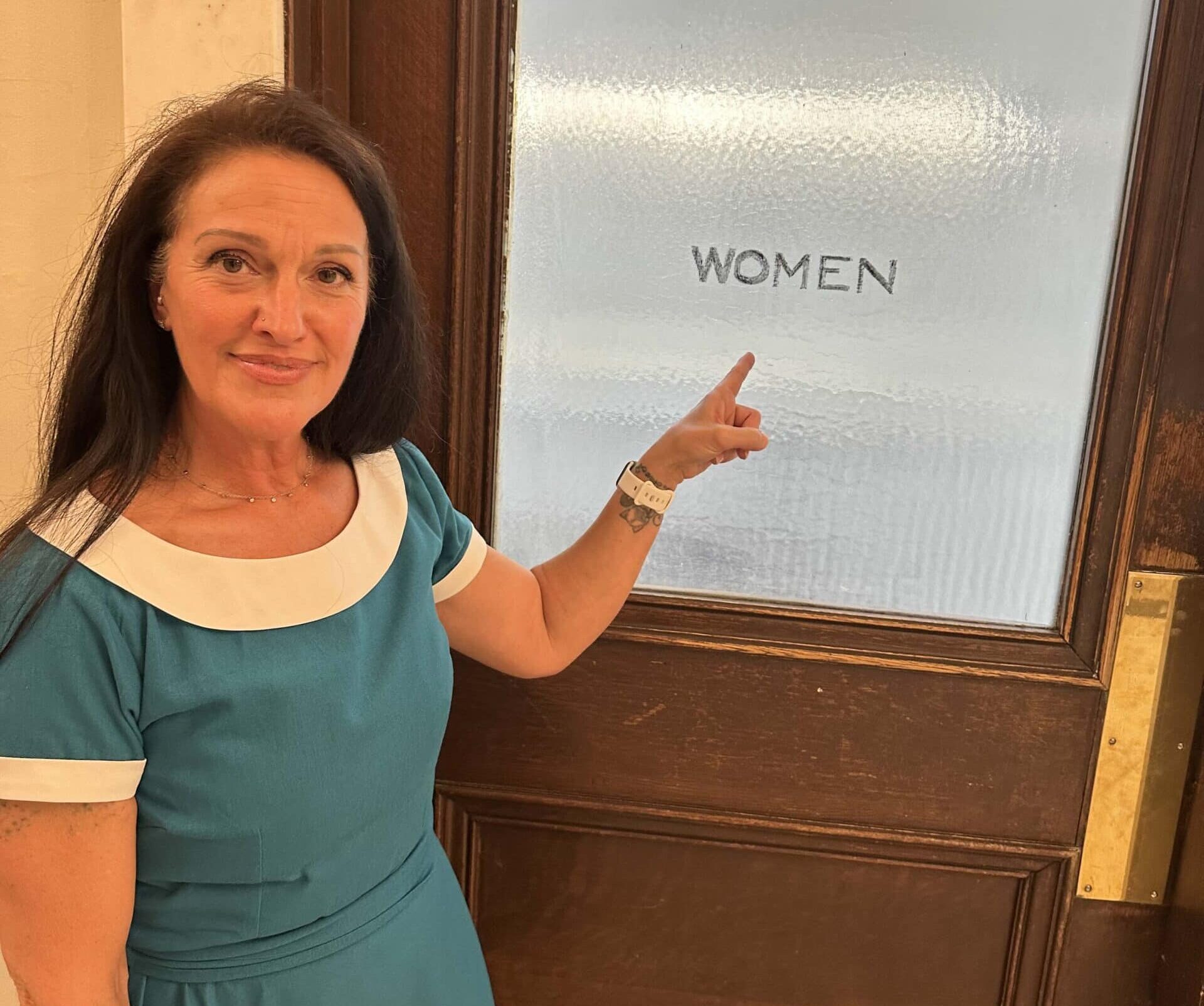
At the recent State House press conference, Rep. Katherine Prudhomme O’Brien testified that she often saw former Rep. Laughton in the women’s bathrooms at the Capitol and knew something was wrong, but stayed silent because the law was not on her side. That testimony matters. Whether one agrees with every policy argument or not, it shows what many women have been saying for years: when the law allows men into women’s private spaces under the banner of ideology, ordinary women are expected to swallow their discomfort and stay quiet.
That silence has consequences.
It is one thing to debate policy in the abstract. It is another to watch a man with a documented criminal history move through women’s spaces while institutions insist nothing is wrong. Women and girls are told to trust the process, trust the experts, and trust the system. But what happens when the system fails to protect them? What happens when the people raising concerns are dismissed as intolerant, alarmist, or hateful?
The answer is already before us.
Laughton was not just a controversial public figure. He was a warning. A person with a history of fraud, instability, deceit, and later child exploitation was able to move through public life with far too little scrutiny. That is not merely a personal failure. It is a public failure. It raises uncomfortable but necessary questions about candidate vetting, party responsibility, media scrutiny, and the cost of ignoring obvious red flags when ideology gets in the way.
That issue is inseparable from New Hampshire’s broader legal history. In 2018, New Hampshire added gender identity protections to its nondiscrimination law when Governor Chris Sununu signed HB 1319 on June 8, 2018. The law added gender identity to the state’s anti-discrimination protections in employment, housing, and public accommodations. Supporters called it a civil rights milestone. Critics warned it would erase necessary sex-based boundaries in places where privacy and safety matter most.
That legal framework is now under renewed constitutional review. The U.S. Supreme Court heard oral argument in Little v. Hecox and West Virginia v. B.P.J. on January 13, 2026. The Court is considering whether laws that require sports participation to be based on biological sex violate the Equal Protection Clause, and whether Title IX forbids states from limiting girls’ and women’s sports to athletes of the female sex at birth. These cases matter because they go to the heart of the same question raised in New Hampshire: whether sex still means anything in law, and whether female-only spaces and opportunities can remain female-only in practice.
I signed the ICONS amicus brief in United States v. Skrmetti because this debate is not abstract. It is about whether law will continue to recognize that biological sex is real, relevant, and material in athletics and other intimate settings. The brief argued that post-puberty male advantages in strength, muscle mass, bone density, and skeletal structure persist even with testosterone suppression, and that forcing women and girls to compete against biological males undermines fairness and Title IX’s original purpose. The legal and cultural stakes are now unmistakable: what New Hampshire chose to protect in 2018, and what it has since been asked to reconsider in bills like SB 552 and HB 1442, is part of a larger national battle now before the Supreme Court.
Governor Kelly Ayotte’s veto of SB 552 only makes that concern more urgent. SB 552 was a narrow, common-sense bill designed to allow sex-based distinctions in bathrooms, locker rooms, sports, prisons, and other intimate spaces. It did not force private entities to do anything; it simply preserved the ability to separate by biological sex where privacy and safety matter most. Yet instead of signing it, the governor chose delay and ambiguity.
That is not leadership. That is avoidance.
Women do not need more slogans. They need protection. They need enforceable boundaries. They need public officials willing to say that biological reality still matters in law, in policy, and in daily life. When those boundaries are erased, the people who pay the highest price are girls, women, and vulnerable people who are expected to accommodate everyone else’s identity claims while their own safety and dignity are treated as negotiable.
This is bigger than one man. Laughton is the most disturbing example of what can happen when institutions stop asking hard questions. But he is not the only example. Across the country, voters are being asked to ignore criminal records, ideological extremism, and obvious conflicts with public trust because the cultural moment says certain questions must not be asked. That is a dangerous way to govern.
The public deserves better than that. New Hampshire women deserve better than that. And girls deserve laws that recognize the difference between political symbolism and real safety.
The central lesson here is simple: when warning signs are ignored, predators benefit and women pay the cost. That is why vetting matters. That is why boundaries matter. And that is why biological sex cannot be erased from the spaces where privacy, fairness, and safety are at stake.
New Hampshire should have learned that lesson already.

