

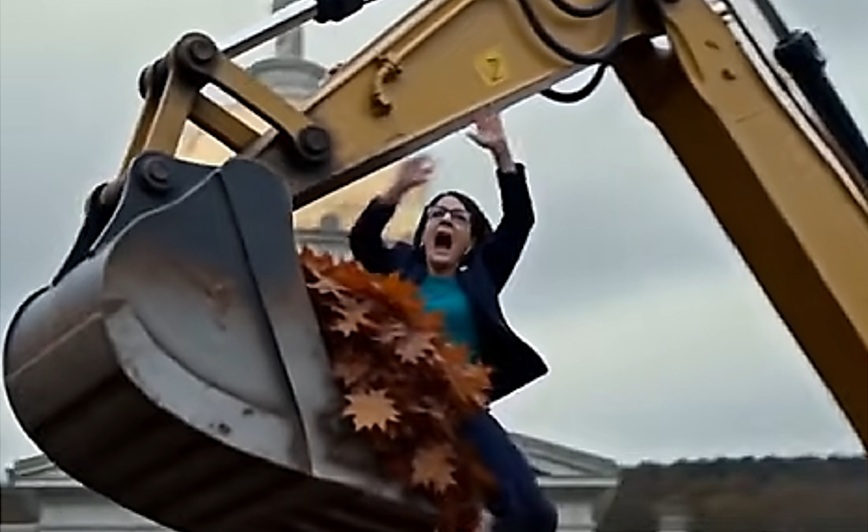
Artificial intelligence has arrived in Vermont politics, and whether you laughed at the latest video or found it offensive, it raises questions that aren’t going away.
An AI-generated cartoon making fun of Congresswoman Becca Balint is making the rounds online. In the video, an artificial version of Rep. Becca Balint (D-Vermont) says things she never actually said, while Republican candidate Mark Coester is portrayed as the hero who literally scoops her up with a backhoe and dumps her in a dumpster.
Balint is furious. She calls it deceptive and dangerous and says it proves the need for federal legislation to prevent unauthorized AI replicas of people’s voices and images.
“This ad is offensive and a dangerous example of what happens when AI is used to deceive voters,” Balint wrote in a statement published in a Facebook post. “Fabricating my voice and image to put words in my mouth is a new low. Free speech is a cornerstone of our democracy, but impersonation and deception are not.”
Balint adds that the video is an example of why she introduced the federal NO FAKES Act to “give people protections against unauthorized AI replicas of their voice and likeness and bring greater transparency and accountability to AI-generated content.”
The producer of the video is not known. Coester says he had nothing to do with it. It appeared on the Planet Hank platform, and someone looking a lot like videographer Hank Poitras appears standing next to Coester in the video.
Technology now allows almost anyone to create convincing fake audio and video. A few years ago that would have taken a Hollywood studio. Today it can be done on a laptop. If voters can’t tell what’s real from what’s fake, democracy has a problem.
But there’s another side to this debate.
Political cartoons have been mocking public officials for hundreds of years. Thomas Nast skewered Boss Tweed. Newspapers routinely exaggerate politicians’ features, words, and actions to make a point. Television shows imitate presidents and governors. Saturday Night Live has built an institution around putting words into politicians’ mouths for laughs.
So where is the line?
If someone creates an AI video and falsely presents it as genuine news footage, that’s deception. If someone uses AI to commit fraud or impersonate another person for financial gain, that’s already illegal in many contexts.
But if AI becomes simply the newest tool for satire, parody and political commentary, banning it outright could collide with the First Amendment.
The answer may not be prohibition but transparency. Require labels. Let viewers know they’re watching synthetic media. Let the audience judge the joke with full knowledge that it’s fiction.
Ironically, this controversy may end up educating more Vermonters about artificial intelligence than any government seminar ever could. People are beginning to realize that seeing is no longer believing.
The technology isn’t going away. The challenge for lawmakers is to stop fraud without outlawing satire, to protect reputations without protecting politicians from ridicule.
Because in America, making fun of elected officials isn’t just allowed. It’s practically a national pastime.
And as AI gets better, we’re all going to need sharper eyes—and perhaps a better sense of humor.
Authors’ and Speakers’ opinions are their own and may not represent those of GraniteGrok.com’s sponsors, readers, authors, or advertisers.
Disagree, agree, Got Something to say? We want to Hear It. Comment or submit Op-Eds to steve@granitegrok.com
