

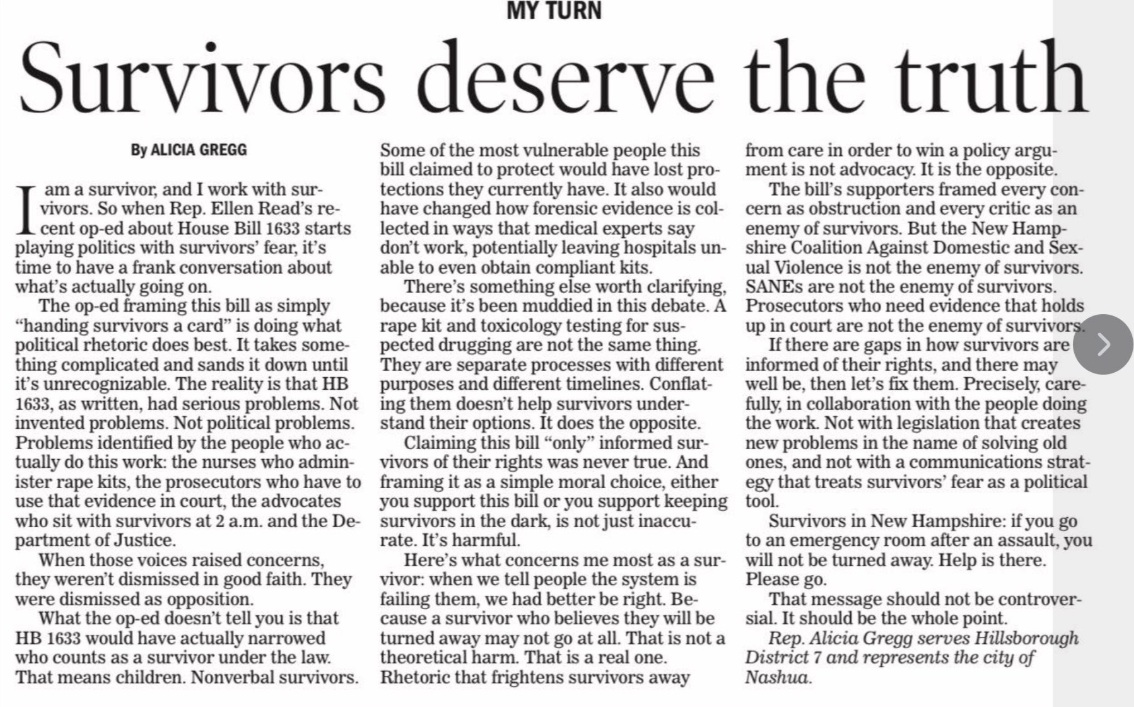
Rep. Alicia Gregg published an op-ed in the *Concord Monitor* this week titled “Survivors deserve the truth.” She opens by establishing her standing — ”I am a survivor, and I work with survivors” — and she closes by accusing Rep. Ellen Read of using “survivors’ fear as a political tool.”
I want to take Rep. Gregg’s title seriously. Because survivors *do* deserve the truth.
All of it.
So let’s tell some.
The truth is that HB 1633 passed the New Hampshire House of Representatives 340 to 1.
Three hundred and forty votes. Out of three hundred and forty-one cast. That is not a controversial bill. That is not a partisan bill. That is not a bill that “plays politics with survivors’ fear.” That is a bill that every Republican, every Democrat, every independent, and every contrarian in the New Hampshire House — *minus one* — looked at and said *yes.* (Looking at Eileen Kelly)
You don’t get 340 votes in the New Hampshire House for a bad bill. You don’t get 340 votes in the New Hampshire House for *most* good bills. The House Republican caucus, the House Democratic caucus, the House Libertarian-adjacent caucus, and the House nobody-knows-what-her-deal-is caucus all looked at HB 1633 and agreed.
The bill died in the Senate.
It died in the Senate Judiciary Committee, where it was sent to “interim study” — a procedural euphemism for *we don’t want to vote on this and we don’t want it to become law.*
Rep. Gregg’s op-ed does not mention the 340-1 vote.
Rep. Gregg’s op-ed does not mention the Senate’s role.
Rep. Gregg’s op-ed presents HB 1633 as Rep. Ellen Read’s personal communications strategy.
I would like to gently suggest that when a bill passes the House 340-1 and dies in the Senate, the news story is not “one House member’s communications strategy.” The news story is what happened in the Senate, and who lobbied them.
The truth is that HB 1633 did one simple thing.
It required that the New Hampshire Victims’ Bill of Rights — which is already the law — be made *available* to victims of sexual and domestic violence. On a palm card. In a hospital. In a police station. Posted publicly.
That is the whole bill. The Victims’ Bill of Rights already exists. HB 1633 just said: *put it where victims can find it.*
Rep. Gregg’s op-ed claims the bill “would have narrowed who counts as a survivor under the law.” That children, Nonverbal survivors, and vulnerable people would have lost the protections they currently have.
That is a “specific” claim. A serious claim. A claim that, if true, would mean the 340 House members who voted for the bill — including the entire House Democratic Caucus, including the eleven survivors I personally know are in that chamber, including the Speaker — somehow missed it.
I have read the bill. I have read it three times. I cannot find the section that “narrows who counts as a survivor.” If Rep. Gregg can point me to the section number and subsection, I will publish a correction. My DMs are open. My phone number is listed, and I have a podcast. I am pretty easy to find.
Until then, I am going to ask the question that nobody in Rep. Gregg’s op-ed asks:
If HB 1633 was so dangerous to survivors, why did the State’s most prominent advocacy organization for survivors — the NHCADSV — not testify against it in House committee?
Why did the opposition only materialize once the bill was already in the Senate?
The truth is that there is a woman named Marisol Fuentes.
You may not have heard her name. She lived in Berlin, New Hampshire. She is no longer with us.
Executive Councilor Janet Stevens has filed a Right-to-Know request with the Berlin Police Department asking, among other things, whether Marisol Fuentes was advised to seek medical care under the Victims’ Bill of Rights.
That is the question Councilor Stevens is asking *because she does not know the answer.*
Nobody knows the answer.
Because — under current New Hampshire law, the law as it exists *without* HB 1633 — there is no requirement that anyone tell a victim what her rights are. There is no palm card. There is no posted notice. There is no mandatory disclosure.
There is only the hope that the officer responding to the scene, the SANE nurse at the hospital, or the prosecutor on the case happens to know the law and shares it.
HB 1633 would have changed that. HB 1633 would have made the question Councilor Stevens is now asking — *did anybody tell her?* — *unnecessary to ask*, because there would have been a printed card and a posted notice and a legal requirement that the answer was *yes.*
That is the truth Rep. Gregg’s op-ed declines to address.
The truth is that the NHCADSV trains New Hampshire police departments in “best practices” for sexual assault investigations.
The Coalition says so. It’s on their website. It’s in their public statements. It’s part of how they justify their state and federal funding.
So I have a question. A simple one. The kind of question a journalist asks, because a journalist has to.
*What training did the Berlin Police Department receive from the NHCADSV on the Victims’ Bill of Rights?*
If the answer is “thorough training, every officer, every year, documented” — then the NHCADSV’s opposition to HB 1633 starts to make a certain kind of sense. “We’ve got this. We don’t need a law. Trust the training.”
If the answer is “we don’t actually track that,” or “training varies by department,” or “we don’t have records of which officers received which modules,” then the NHCADSV’s opposition to HB 1633 starts to look very different.
It starts to look like an organization protecting its monopoly on “best practices” by opposing a law that would have made best practices *unnecessary to mediate.*
A palm card does not need to be trained. A posted notice does not need a contract. A printed Bill of Rights does not require an annual “best practices” curriculum from a single coalition with privileged access to law enforcement statewide.
HB 1633 would have routed around the NHCADSV.
That, I suspect, is the actual reason the NHCADSV opposed it.
The truth is that Rep. Ellen Read is, by independent measure, the single most effective Democratic lawmaker in the New Hampshire House of Representatives.
This isn’t my opinion. This is the State Legislative Effectiveness Score — a peer-reviewed academic metric, published for the 168th NH House — that ranks her as the **#1 most effective Democratic lawmaker in the chamber.** Out of all 200 Democrats. With a score of 6.50, well ahead of the next-closest member.
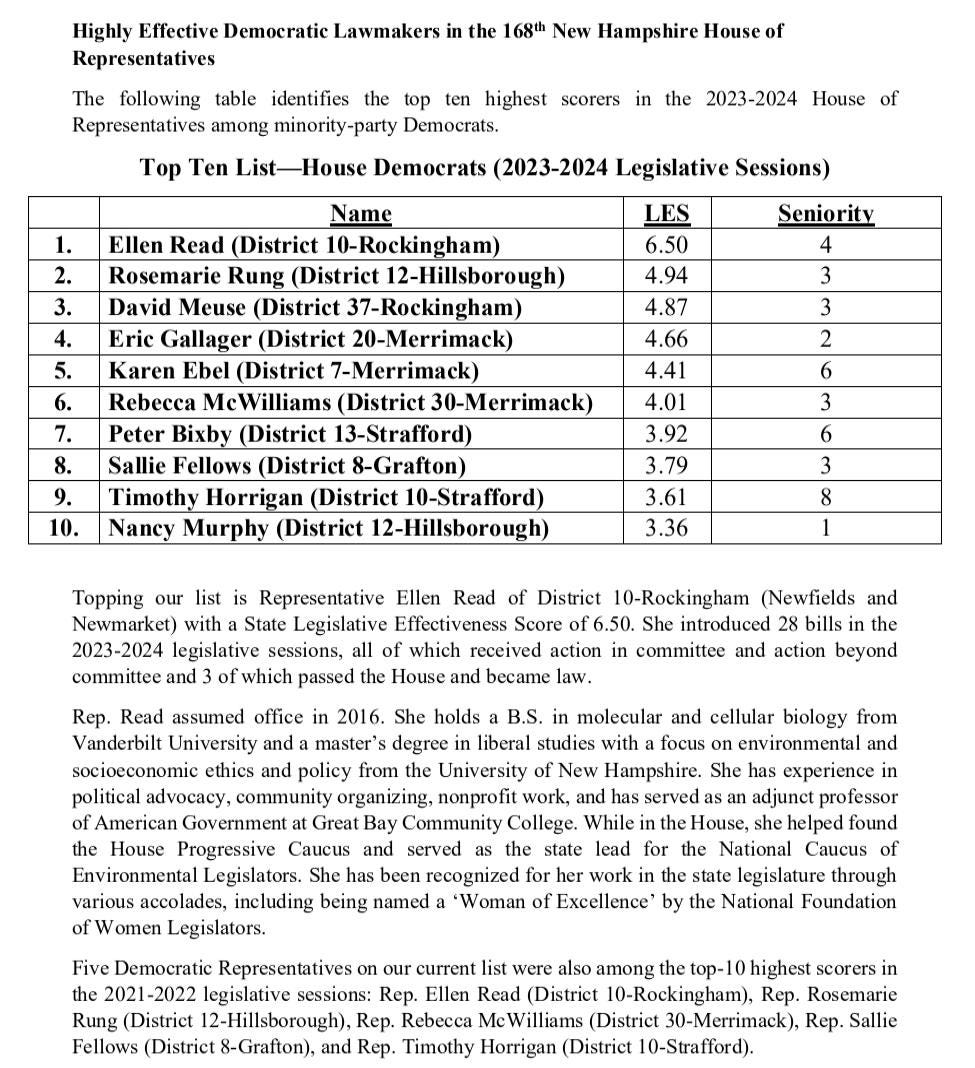
Twenty-eight bills introduced. *All twenty-eight* received committee action. Three passed the House and became law.
That is what effectiveness looks like.
It does not look like “playing politics with survivors’ fear.” It looks like introducing 28 bills and making 28 of them go somewhere.
Rep. Gregg’s op-ed does not engage with Rep. Read’s effectiveness record. It engages with a *characterization* of Rep. Read’s communications strategy.
I would like to gently suggest: when the most effective Democratic lawmaker in the House introduces a bill that passes 340-1, and the bill dies in the Senate, and an op-ed appears in the “Concord Monitor” attacking the lawmaker’s communications strategy rather than engaging the bill — the op-ed is not journalism. The op-ed is “damage control.”
Survivors deserve to know who it’s being done for.
Survivors deserve the truth. Here it is.
A bill that would have put the Victims’ Bill of Rights on a palm card died in the Senate after passing the House 340-1.
The advocacy organization that opposed it has a documented business relationship with the police departments and prosecutors who would have had to comply with it.
A woman in Berlin is dead, and an Executive Councilor is filing a Right-to-Know request because nobody can say whether she was told her rights.
And the *Concord Monitor* published an op-ed framing the bill’s sponsor as the problem.
Survivors deserve better than that.
So do New Hampshire taxpayers.
So does Marisol Fuentes.
—
*Gracie Gato is an investigative journalist and host of Gracie Gato’s Speakeasy. She is also Communications Director for Rep. Ellen Read.*
This response was written in the author’s capacity as a journalist and independent commentator.
Authors’ and Speakers’ opinions are their own and may not represent those of Grok Media, LLC, GraniteGrok.com, its sponsors, readers, authors, or advertisers.
Disagree, agree, Got Something to Say, We Want to Hear It. Comment or submit Op-Eds to steve@granitegrok.com
