

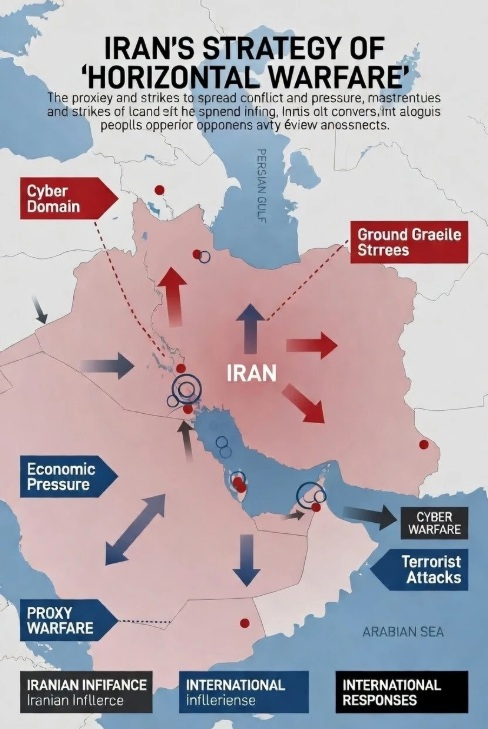
Horizontal escalation occurs when a state at war widens the geographic and political scope of the conflict, rather than intensifying it vertically in a single theater of operations. It is especially appealing as a strategy for the weakest side in a military contest.
Instead of trying to defeat a stronger adversary head-on, the weaker side multiplies arenas of risk – drawing additional states and economic sectors into the conflict. The Iranian missile and drone barrages that have hit gas, oil, water, air, electricity, tourism infrastructure across the Gulf and beyond, and now shipping in the Strait of Hormuz, are not acts of scattered retaliation nor the flailing lashings of a dying regime, but instead, a carefully conceived strategic plan to render an attacker, presumably the United States, economically and subsequently, morally unable, to sustain military operations against them.
It is the strategy of transforming the stakes of a conflict by drawing in neighboring states, which may or may not be directly involved, and extending the duration of the conflict without engaging the attackers head-on. The objective is to gain the upper hand politically by causing voters, investors, and allies of the attacker – tacit or otherwise – to rethink their support for the campaign.
Nowhere is this more evident than in the Gulf states, where the autocracies of Saudi Arabia, the United Arab Emirates, Qatar, Bahrain, and Oman, among others, have long feared exactly the sort of uprising that toppled the US-backed Shah of Iran in 1979, and ushered in the Islamic Republic.
By bombing a broad range of civilian infrastructure in these countries, Iran is not just causing physical, economic, and human damage, but pressuring those regimes to rethink their relations with Israel and America, lest they face popular discontent, which is exactly what is happening right now.
That is why Iran apologized to “neighboring Muslim countries” on Saturday, even as its missiles and drones continued to target them. The message was directed at those countries’ citizens, not to their rulers, who, in Iran’s view, are betraying them. The longer the conflict continues, the harder it becomes for the rulers to sustain that partnership with Israel [and the US], without sacrificing legitimacy at home, not to mention the impact on trillions of dollars to their economies.
Iran’s defense strategy was conceived to cause volatility in the price of oil, gas, and other commodities upon which the economies of the Gulf states and European allies are dependent, therefore, placing enormous political and economic pressure on the United States to stop any serious military excursions into Iran.
Even before the US-Israeli strikes started on March 2, the Gulf states, with the possible, but unconfirmed exception of Saudi Arabia, were urgently trying to get Trump to do a deal with Iran, rather than resorting to military action. The same is true of the UK and America’s allies in Europe, Turkey, Iraq, and even Lebanon.
The fact is, the longer this operation continues, the stronger Iran looks in the Islamic world, the higher the volatility in the world markets, the greater the likelihood of economic hardship for even countries not directly involved in the conflict, and the pressure on politicians from the citizenry of these countries to stop the conflict. And so far, Iran is still launching missiles and drones.
